Why Outdoor Scrubbers Freeze in Winter
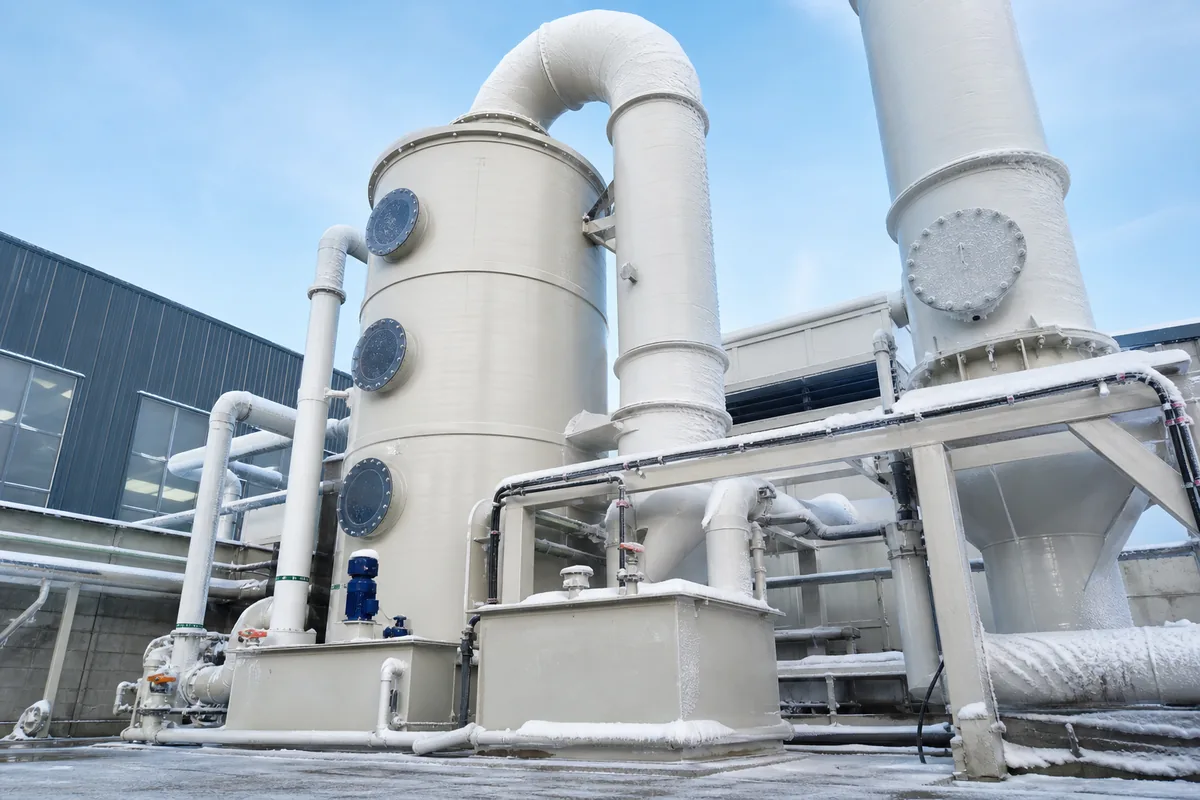
For an outdoor wet scrubber, freezing is not only a cold-weather problem. It is a process reliability problem. Ice can block spray nozzles, crack PP piping, damage pumps, stop chemical dosing, and overload the fan due to higher pressure drop. Good scrubber freeze protection should be considered during design, not only after the first winter shutdown.
Most PP wet scrubbers operate with recirculating liquid. The freezing risk depends on:
- Minimum ambient temperature, including night temperature and wind chill effect
- Scrubber operating schedule: continuous, intermittent, or standby
- Liquid chemistry and freezing point
- Size of sump, piping, spray header, and external tank
- Whether water is moving or stagnant
- Heat loss from the scrubber body, ducts, and circulation lines
- Emergency shutdown duration
As a rule of thumb, if the local minimum ambient temperature can fall below 0°C for more than 4–6 hours, freeze protection should be reviewed. If the minimum temperature is below -10°C, passive measures alone are usually not enough for outdoor equipment containing water.
PP material itself has good corrosion resistance, but like most plastics, it becomes less impact-resistant at low temperature. Ice expansion inside a closed PP pipe or valve can split the component. Therefore, the design target is not only to keep the scrubber running, but also to avoid trapped water during shutdown.
Identify the High-Risk Locations
In many plants, the scrubber sump does not freeze first. The first failures often appear in small external lines, nozzles, instruments, and drain points.
Typical high-risk locations include:
- Recirculation pump suction and discharge lines
- Spray header and branch piping
- Small-bore chemical dosing lines
- pH and ORP sensor chambers
- Conductivity probes and flow switches
- Sight glasses, level gauges, and pressure impulse lines
- Drain valves with trapped liquid
- Mist eliminator wash water line
- Outdoor fresh water make-up line
- Low points in PP ducting where condensate collects
A useful check is to walk the system and ask: “If the pump stops now, where will water remain?” Any dead leg or horizontal pipe without slope is a freezing point.
For PP ducting, freeze risk comes from condensation. Acidic or alkaline mist can condense in cold duct sections. If the duct has a low point without drainage, ice can form and reduce the cross-section. For winter design, outdoor ducts should generally slope 1–2% toward a drain or scrubber inlet where liquid can be collected safely.
Main Freeze Protection Methods
There is no single method suitable for every plant. The correct solution depends on ambient temperature, operating hours, process liquid, and maintenance capability.
| Method | Typical Use | Advantages | Limitations |
|---|---|---|---|
| Continuous circulation | Mild winter, 24-hour operation | Simple, uses process pump heat | Not safe during power failure or long shutdown |
| Electric heat tracing | Pipes, valves, instruments | Accurate, easy to control by thermostat | Needs correct installation and electrical maintenance |
| Thermal insulation | Scrubber body, tank, pipe | Reduces heat loss | Does not generate heat by itself |
| Antifreeze solution | Selected scrubbing liquids | Lowers freezing point | Must be compatible with process and wastewater treatment |
| Drain-down design | Intermittent operation | Prevents trapped water | Requires proper slope and reliable automatic valves |
| Indoor pump skid/enclosure | Cold regions | Protects pumps and instruments | Needs space and ventilation |
| Hot water or steam coil | Large tanks/sumps | High heat input | More complex control and corrosion review |
For many outdoor PP scrubbers, the most practical arrangement is a combination:
- Insulate the sump, external tank, and main recirculation line.
- Apply electric heat tracing to small pipes, valves, and instruments.
- Keep the circulation pump running during short stops if safe for the process.
- Provide automatic drain-down for standby or emergency shutdown.
- Install low-temperature alarms and interlocks.
Insulation thickness depends on climate and equipment size. Common starting points are:
- 25–40 mm insulation for areas near 0 to -5°C
- 50–75 mm insulation for -5 to -20°C
- 75–100 mm or more for colder sites or exposed windy locations
The insulation jacket must be weatherproof. Wet insulation loses much of its value and may hide corrosion or mechanical damage.
Heat Tracing and Heat Loss: Practical Rules
Electric heat tracing is widely used for scrubber freeze protection because it can be installed on PP piping and controlled locally. However, it must be sized correctly.
A simplified heat loss estimate for insulated pipe is:
`text Q = U × A × ΔT `
Where:
Q= heat loss, WU= overall heat transfer coefficient, W/m²·KA= outside surface area of pipe or tank, m²ΔT= temperature difference between liquid and ambient, K
For practical early design, many engineers use heat tracing power by pipe size:
| Pipe Size | Typical Heat Tracing Power for Freeze Protection* |
|---|---|
| DN15–DN25 | 10–20 W/m |
| DN32–DN50 | 15–30 W/m |
| DN65–DN100 | 25–45 W/m |
| DN125 and above | Calculate by heat loss |
\*These are starting values only. Final design depends on insulation thickness, minimum ambient temperature, wind exposure, required liquid temperature, and heat tracing type.
For PP piping, self-regulating heat cable is often preferred because it reduces output as temperature rises. Still, cable surface temperature must be suitable for PP. Avoid direct overheating at cable overlaps, pipe supports, and sensor locations. Follow the heat cable supplier’s installation instructions.
Important details:
- Place the thermostat sensor on the coldest representative pipe section.
- Heat trace valves, strainers, flanges, and pump casing drains, not only straight pipe.
- Use aluminum foil tape between cable and plastic pipe where recommended to improve heat distribution.
- Protect heat tracing from UV, water ingress, and mechanical damage.
- Test insulation resistance before winter and after maintenance.
A common control setting is to start heat tracing at 3–5°C and stop at 8–10°C. For critical systems, use two sensors: one for control and one for low-temperature alarm.
Shutdown, Standby, and Emergency Conditions
Many freeze failures occur when the scrubber is not operating. A scrubber that is safe during normal operation may freeze during a weekend stop.
For intermittent operation, the design should define one of three strategies:
1. Wet standby
The sump remains filled, heat tracing is active, and circulation runs periodically or continuously. This is suitable when power supply is reliable and ambient temperature is not extremely low.
A practical setting is to run the recirculation pump for 5–10 minutes every 30–60 minutes, but this depends on pipe length, liquid volume, and heat loss. If the outdoor temperature is below -10°C, continuous circulation is often safer than cycling.
2. Drain-down standby
The scrubber liquid is drained to an indoor or heated tank. Piping slopes back to the sump or drain point. Automatic valves open on shutdown or low-temperature alarm.
For drain-down to work, check these points:
- Pipe slope should be continuous, typically minimum 1%, preferably 2%.
- No check valve should trap liquid in a vertical or horizontal section.
- Spray headers should have drain holes or low-point drains.
- Instruments should be isolated and drained or installed in heated boxes.
- Drain valves should be accessible and protected from freezing.
3. Dry shutdown
The system is washed, drained, and left dry. This is often used for seasonal shutdown. The mist eliminator, sump bottom, pump casing, and all low-point drains must be checked manually. Do not assume “drained” means “empty.” Small volumes trapped in valves and pump casings are enough to cause damage.
Emergency conditions also need planning. If the plant loses power at night, heat tracing and pumps stop. For cold climates, consider:
- UPS power for control system and critical valves
- Normally open drain valves for fail-safe drain-down
- Low-temperature alarm sent to operator phone or control room
- Written winter emergency procedure
- Spare nozzles, gaskets, sensors, and small PP valves on site
Chemical selection may also help, but it must be reviewed carefully. For example, glycol can reduce freezing point, but it may affect VOC absorption, wastewater treatment, foaming, or discharge limits. Salt solutions can lower freezing point but may increase corrosion risk for metal parts and instruments. Do not add antifreeze without process and environmental review.
Maintenance Checks Before the First Frost
A winter inspection should be done before the temperature reaches 0°C. It is easier to repair heat tracing and insulation in autumn than during an emergency freeze.
Recommended checklist:
- Confirm all heat tracing circuits are powered and labeled.
- Measure current draw and compare with design value.
- Inspect insulation for gaps, water ingress, and damaged cladding.
- Open and close drain valves to confirm they are not blocked.
- Clean strainers and spray nozzles before winter.
- Check pump mechanical seal leakage and casing drain.
- Calibrate low-temperature alarms and verify alarm transmission.
- Confirm sump level control and make-up water valve operation.
- Remove standing water from outdoor duct low points.
- Review shutdown procedure with operators and maintenance staff.
During winter operation, monitor differential pressure across the scrubber. A sudden increase may indicate ice, blocked mist eliminator, or frozen drain. Typical packed-bed scrubber pressure drop depends on design, but a change of 20–30% above normal operating value should be investigated.
Practical Next Step
Before winter, make a simple freeze-risk drawing of your scrubber system. Mark every outdoor pipe, valve, instrument, drain, and low point that can hold liquid. Then decide for each item: heat trace, insulate, continuously circulate, or drain.
If you are specifying a new outdoor scrubber, provide the equipment supplier with:
- Minimum and average winter ambient temperature
- Wind exposure and installation height
- Operating schedule and longest expected shutdown
- Scrubbing liquid composition and concentration
- Available power for heat tracing or heating
- Requirement for automatic drain-down or wet standby
With this information, the supplier can design scrubber freeze protection into the equipment layout instead of adding temporary heating after installation.