The Real Problem Is Often Droplet Carryover
Sulfuric acid mist is not only a gas cleaning problem. In many plants, the visible plume, duct corrosion, fan damage, and stack acid rain are caused by liquid droplets leaving the scrubber, not by poor neutralization alone.
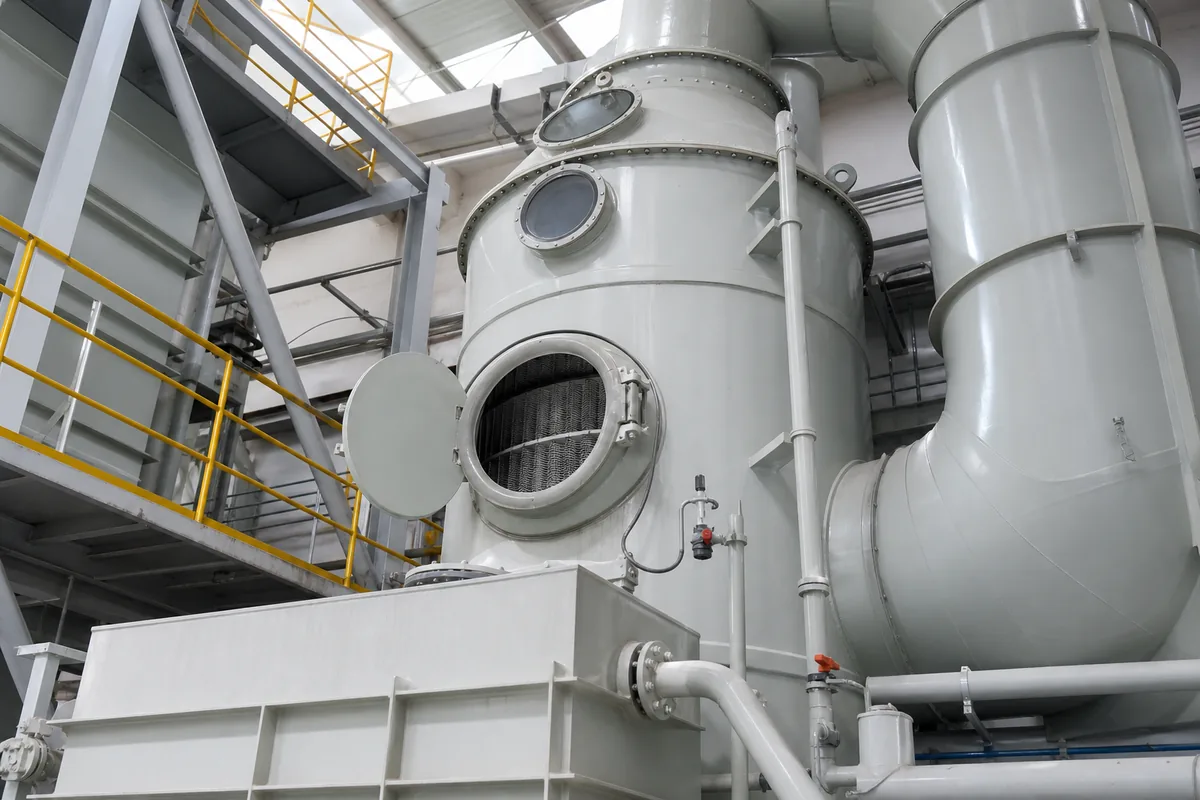
A typical sulfuric acid mist scrubber may remove acid by absorption, impaction, and condensation inside a packed bed or spray tower. But after the gas contacts recirculated liquid, it becomes saturated and carries fine droplets upward. If these droplets are not removed before the outlet, the scrubber becomes a “droplet generator.”
Common symptoms of poor mist control include:
- White or blue-white plume at the stack, especially in humid weather
- Acid droplets found inside the fan casing or outlet duct
- Low pH condensate draining from duct flanges
- Rapid corrosion of metal stack parts downstream
- Increased vibration due to fan blade fouling
- Complaint that “the scrubber is not working” even when pH and pump flow are normal
For sulfuric acid service, the demister is not an accessory. It is one of the key separation stages. In many real installations, improving the demister design gives a bigger benefit than increasing chemical dosage.
What Makes Sulfuric Acid Mist Difficult
Sulfuric acid mist can form in several ways:
- Direct process emission
Acid pickling, anodizing, battery production, chemical mixing, and acid storage ventilation can release droplets from open tanks or vents.
- Condensation in hot gas
If SO₃, H₂SO₄ vapour, or hot acid gas cools below its dew point, very fine acid mist forms. These droplets can be below 1–3 µm, which are difficult to capture with simple mesh pads.
- Scrubber-generated entrainment
High spray velocity, excessive gas velocity, poor liquid distribution, or flooding in packing can create large droplets and carry them into the outlet.
Droplet size is critical. Large droplets are easy to remove; submicron mist is much harder.
| Mist or Droplet Type | Typical Size Range | Main Source | Separation Difficulty | Common Control Method |
|---|---|---|---|---|
| Spray carryover | 50–500 µm | Nozzles, flooded packing | Low | Mesh pad, chevron demister |
| Packed bed entrainment | 10–100 µm | High gas velocity, liquid film break-up | Medium | Mesh pad, multi-layer demister |
| Condensed acid mist | 0.5–10 µm | Cooling of acid vapour | High | Fiber bed, wet electrostatic precipitator, special high-efficiency design |
| Submicron aerosol | <0.5 µm | SO₃/H₂SO₄ condensation | Very high | Usually requires special equipment; wet scrubber alone may not be enough |
This is why a sulfuric acid mist scrubber must be selected based on inlet mist size and loading, not only gas flow rate.
A useful rule of thumb: if the stack plume appears even when the demister is clean and the scrubber pH is correct, the issue may be fine mist formation, not simple acid neutralization.
Demister Types and Practical Selection
The most common demister materials for sulfuric acid mist scrubbers are PP, PVC, FRP-supported plastics, and sometimes PTFE or PVDF for higher temperature or stronger chemical conditions. For many low- to medium-temperature acid ventilation systems, PP demisters are widely used because of corrosion resistance and good fabrication flexibility.
The main demister types are:
Mesh Pad Demister
A mesh pad uses interlaced plastic filaments to capture droplets by impaction. Droplets hit the fibers, combine into larger drops, and drain downward.
Typical design data:
- Recommended face velocity: 1.5–3.5 m/s, depending on mesh density and liquid load
- Pressure drop when clean: 100–300 Pa
- Common thickness: 100–200 mm
- Effective for droplets: usually >3–5 µm, depending on design
Mesh pads are good for general acid tank ventilation and packed tower outlets. However, they can plug if the gas contains solids, crystallized salts, or sticky contaminants.
Chevron or Vane Demister
A chevron demister changes the gas direction several times. Droplets cannot follow the gas path and impact the blade surface.
Typical design data:
- Recommended face velocity: 2.5–5.0 m/s
- Pressure drop when clean: 100–400 Pa
- Good for high liquid loading
- Easier to wash than dense mesh
Chevron demisters are strong and practical for spray towers or systems with heavy droplet carryover. They are less efficient for very fine mist compared with dense mesh or fiber designs.
Fiber Bed Mist Eliminator
A fiber bed uses fine fibers and a deeper structure to collect smaller aerosols. It is usually applied where acid mist is fine and difficult to remove.
Typical design data depends strongly on supplier design, gas temperature, acid concentration, and mist size. Face velocities are usually much lower than vane or mesh types. The pressure drop can also be higher.
Fiber bed systems may be needed for sulfuric acid plants, SO₃ service, or hot gas condensation problems. A normal packed-bed sulfuric acid mist scrubber should not be assumed to replace a properly designed fiber bed when submicron mist is present.
Key Design Checks Engineers Should Not Skip
A demister fails more often because of wrong application conditions than because of material failure. Before sizing or buying a scrubber, check these points.
1. Gas Velocity Through the Demister
Face velocity is calculated as:
`text V = Q / A `
Where:
V= face velocity, m/sQ= actual gas flow rate, m³/sA= free cross-sectional area at demister, m²
Use actual gas volume, not normal volume. Hot, humid gas has a larger actual flow.
Example:
`text Gas flow = 18,000 m³/h = 5.0 m³/s Scrubber internal diameter = 1.8 m Area = 3.14 × 1.8² / 4 = 2.54 m² Face velocity = 5.0 / 2.54 = 1.97 m/s `
This is acceptable for many mesh pad demisters. If the diameter were only 1.2 m, the velocity would be 4.42 m/s, which may cause re-entrainment.
2. Distance Above Spray or Packing
If the demister is too close to spray nozzles or the top of packing, it receives heavy liquid impact and may flood.
Typical minimum distances:
- Above spray nozzle zone: 500–800 mm
- Above packed bed: 300–600 mm
- Below outlet nozzle: 300–500 mm
These are practical starting values. Larger scrubbers or high liquid loads may need more space.
3. Drainage Path
Captured acid must drain back without being blown upward again. Poor drainage causes flooding and high pressure drop.
Good practice includes:
- Install demister level and fully supported
- Avoid blocking the bottom of mesh pads with plates
- Provide enough free space for liquid drainage
- Use hold-down grids for high gas velocity
- Add wash nozzles if salts or solids may deposit
4. Pressure Drop Monitoring
A clean demister has a stable pressure drop. Increasing pressure drop usually means fouling, salt build-up, or flooding.
For many PP scrubbers, it is useful to install pressure taps:
- Before packed bed
- After packed bed
- After demister or at outlet duct
A simple differential pressure gauge can help maintenance staff identify whether the problem is packing fouling or demister plugging.
Operation Problems That Look Like Scrubber Failure
When a sulfuric acid mist scrubber has outlet mist, operators often adjust caustic concentration first. This may not solve the problem.
Check these items before changing the chemical program:
- Scrubber pH: For acid neutralization, many systems operate around pH 7–9, but the correct value depends on wastewater limits and process chemistry.
- Liquid-to-gas ratio: Common packed scrubbers may use 2–8 L/m³ of gas, depending on inlet loading and removal target.
- Nozzle condition: Broken or oversized nozzles create large droplets and increase carryover.
- Packing flooding: High recirculation flow or blocked packing can push liquid into the demister.
- Fan position: An induced-draft fan after the scrubber protects the fan less if demister carryover is poor. Acid droplets will still attack the fan.
- Temperature drop: Cooling inside ducting may create acid mist after the scrubber if vapour remains in the gas.
- Gas flow increase: Production expansion often increases airflow beyond the original demister velocity limit.
Maintenance intervals depend on the process. For clean acid tank ventilation, inspection every 1–3 months may be enough. For gas with salts, dust, or metal fumes, weekly visual checks may be needed at the beginning until the fouling rate is understood.
A demister wash system is often useful. For sulfuric acid service, wash water material compatibility and wastewater handling must be considered. Washing too often wastes water; washing too little allows plugging. A practical method is to start with scheduled washing, then adjust based on pressure drop trend.
Practical Next Step
If your scrubber has visible acid mist, fan corrosion, or wet acidic ducting, do not only ask for a larger pump or more chemicals. Collect these data first:
- Actual gas flow rate, temperature, and humidity
- Inlet acid concentration or estimated mist loading
- Process source: tank ventilation, hot gas, SO₃, spray, or condensation
- Existing scrubber diameter and demister type
- Pressure drop across packing and demister
- Photos of outlet duct, stack, demister, and fan inlet
With this information, a supplier can check whether your current sulfuric acid mist scrubber needs a better demister, lower gas velocity, wash system, or a different mist control technology.