Why the Number of Stages Matters
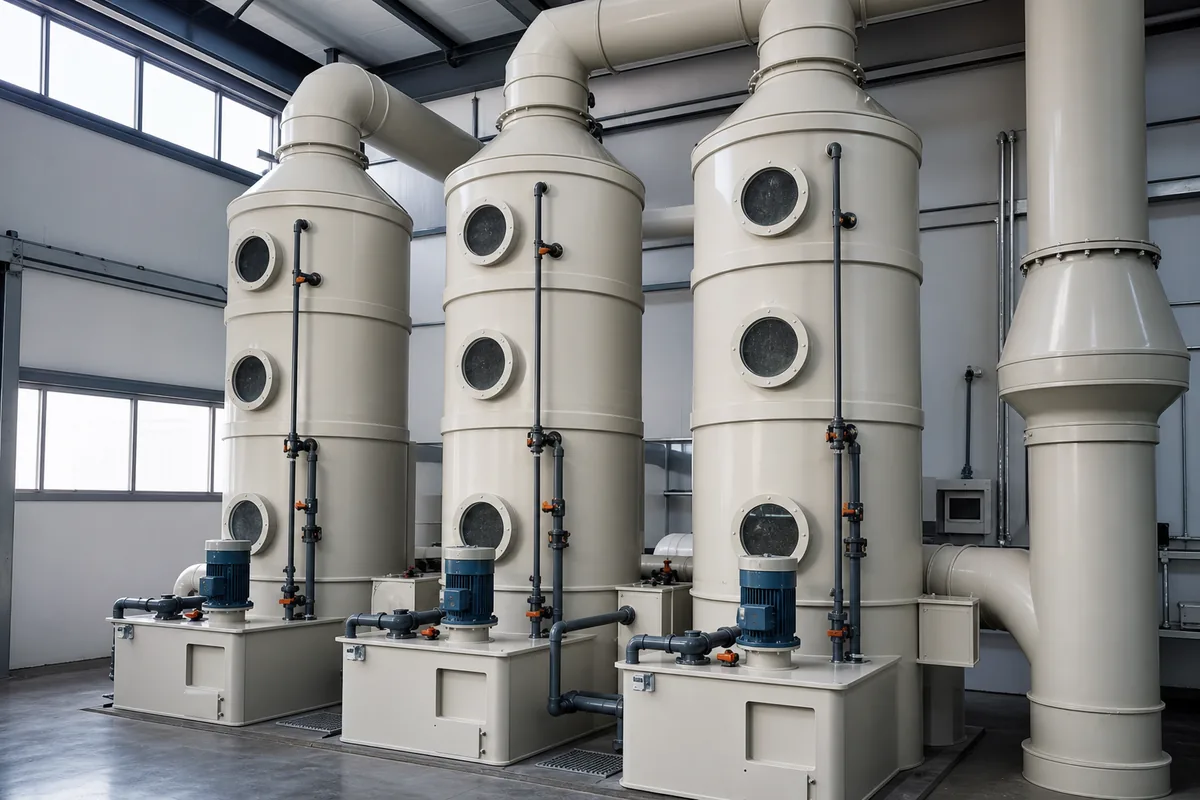
A wet scrubber stage is one contact zone where contaminated gas meets scrubbing liquid. In PP scrubbers, this is often a packed bed with spray nozzles, a sump, a circulation pump and a mist eliminator. A “two-stage” or “three-stage” scrubber normally means two or three separate contact zones, often with separate chemical dosing and sometimes separate recirculation tanks.
The purpose of adding stages is not just to make the scrubber taller. A multi-stage design can solve several real process problems:
- Different pollutants need different chemistry, for example acid gas plus alkaline gas.
- One pollutant has a high inlet concentration and needs higher removal efficiency.
- The gas contains particles, mist, sticky vapour or soluble salts before final absorption.
- The outlet limit is tight, so one packed bed does not provide enough mass transfer.
- Chemical consumption or wastewater quality must be controlled more carefully.
Good multi stage scrubber selection starts with the gas composition, not with the equipment size. A single-stage scrubber can be correct for many duties. A three-stage scrubber can be unnecessary if the contaminant is simple and the emission limit is moderate.
Single-Stage Scrubber: Simple and Suitable for Many Duties
A single-stage packed bed scrubber is usually the first option for one main contaminant with predictable concentration. Common applications include acid fumes from pickling, plating, etching, laboratory exhaust and chemical storage tank vents.
Typical operating ranges for a PP vertical packed tower are:
| Parameter | Common design range | Notes |
|---|---|---|
| Superficial gas velocity | 1.0–2.0 m/s | Lower for high mist or high efficiency |
| Packing height | 0.8–1.5 m | Depends on gas solubility and required removal |
| Liquid-to-gas ratio, L/G | 1–3 L/m³ gas | Higher for high load or heat release |
| Pressure drop | 800–1800 Pa | Including packing and mist eliminator |
| Circulation pH | Acid gas: pH 8–10 | For HCl, HF, SO₂ with alkaline dosing |
| Mist eliminator velocity | 2.5–4.0 m/s | Depends on type and droplet loading |
For very soluble gases such as HCl or NH₃, a single stage can often achieve high removal if the pH is controlled and the packing is not overloaded. For example, HCl absorption into alkaline water is usually easier than VOC absorption into water.
A simple engineering check is removal target:
\[ \text{Removal efficiency} = \frac{C_{in} - C_{out}}{C_{in}} \times 100\% \]
If inlet HCl is 100 mg/Nm³ and the outlet requirement is 10 mg/Nm³, the required removal is 90%. This is normally practical in one well-designed alkaline packed bed. If the outlet limit is 1 mg/Nm³, the required removal is 99%, and a second polishing stage may be safer.
Single-stage scrubbers are preferred when:
- There is one main pollutant.
- The gas temperature is moderate, usually below 50–60°C for standard PP.
- Dust or sticky mist is low.
- The process load does not change sharply.
- Wastewater from one chemical system is acceptable.
The weakness of a single stage is limited flexibility. If acid and alkaline gases enter together, one pH cannot be ideal for both. If oil mist or solids enter the packing, blockage can reduce performance quickly.
Two-Stage Scrubber: The Common Choice for Mixed or Tight Duties
A two-stage scrubber gives two independent treatment steps. This is often the best balance between performance, size and operation complexity.
Common two-stage arrangements include:
| Process problem | Stage 1 | Stage 2 | Typical reason |
|---|---|---|---|
| Acid gas with high load | Alkaline absorption | Alkaline polishing | Higher removal efficiency |
| Acid + ammonia | Acid absorption for NH₃ | Alkaline absorption for acid gas | Different pH needed |
| Dust + acid gas | Water quench/pre-wash | Chemical absorption | Protect packing and reduce salts |
| Hot gas + soluble gas | Cooling/quench | Absorption | Reduce temperature before main bed |
| Odour + acid gas | Chemical scrubber | Activated carbon or second chemical stage | Remove remaining odour components |
A key advantage is pH separation. For ammonia, an acid scrubbing liquid is normally used, often around pH 2–4 depending on the acid selected and wastewater requirements. For HCl or HF, alkaline liquid may be controlled around pH 8–10. Trying to remove both in one sump can waste chemicals and cause unstable outlet concentration.
Two stages are also useful when the first stage receives shock load. For example, a first-stage alkaline bed can remove most acid gas, while the second stage runs at a more stable pH as a polishing bed. This improves resistance to process fluctuation.
For packed tower design, a practical rule is that two moderate packed beds are often more reliable than one very tall bed. A single packed bed above about 1.5–2.0 m may have liquid distribution problems if the distributor is not designed well. Splitting into two beds allows better control, easier inspection and separate chemical adjustment.
Typical two-stage design ranges:
- Stage 1 packing height: 0.8–1.5 m
- Stage 2 packing height: 0.8–1.2 m
- Total pressure drop: 1500–3000 Pa
- Separate circulation tanks: recommended when chemistry is different
- Shared tank: possible only when both stages use the same liquid and pH
Two-stage scrubbers need more instruments and maintenance points than single-stage units. At minimum, each chemical stage should have pH monitoring, circulation flow indication or pressure gauge, pump access and blowdown connection. If the first stage removes high salt load, conductivity control is useful to decide blowdown frequency.
Three-Stage Scrubber: For Difficult Gas Streams and Low Outlet Limits
A three-stage scrubber is normally selected when the gas stream has several pollutants or when the outlet requirement is difficult. It is not automatically “better”; it must match the process.
Typical three-stage configurations are:
- Pre-wash or quench
- Removes dust, soluble salts or condensable mist.
- Cools hot gas before chemical absorption.
- Often uses water or weak recycled solution.
- Main chemical absorption
- Removes the main acid or alkaline pollutant.
- Uses controlled pH and higher chemical dosing.
- Polishing stage
- Removes remaining trace gas or odour.
- May use different oxidizing or reducing chemistry depending on pollutant.
- May also be followed by activated carbon if VOC or odour compounds are not water-soluble.
Three stages may be justified for gases containing combinations such as HCl + Cl₂, NH₃ + amines, acid mist + fluorides, or process exhaust with variable peaks. For chlorine, for example, alkaline absorption with a suitable reducing agent may be needed; the exact chemistry depends on local regulation, safety practice and wastewater treatment. Do not assume that normal caustic washing alone is enough for all oxidizing gases.
A three-stage system can also reduce operational risk. If Stage 1 is fouled by particles, Stage 2 and Stage 3 may still protect the outlet for a limited time. However, this does not replace maintenance. More stages mean more pumps, nozzles, demisters, sensors and drain points.
Expected total pressure drop for three packed stages is commonly 2500–4500 Pa. The fan must be selected at the required operating flow plus system resistance, including ducting, elbows, dampers, scrubber internals, mist eliminators and stack losses. For PP duct systems, keeping duct velocity around 10–16 m/s is common for corrosive gas. Higher velocity reduces duct size but increases pressure drop and noise; lower velocity may allow condensation or solids deposition.
Practical Selection Rules and Common Mistakes
The table below gives a practical comparison for early design discussion.
| Selection factor | Single stage | Two stage | Three stage |
|---|---|---|---|
| Main use | One simple pollutant | Mixed pollutants or high removal | Complex gas or very low outlet target |
| Chemistry | One pH system | Two pH or polishing possible | Pre-wash + main + polishing possible |
| Typical removal target | Moderate to high | High | High to very high |
| Operation complexity | Low | Medium | High |
| Pressure drop | Lowest | Medium | Highest |
| Footprint/height | Smallest | Larger | Largest |
| Best example | HCl from one pickling line | NH₃ + acid gas, or high HCl load | Dust + acid gas + odour/oxidizer |
During multi stage scrubber selection, check these points before deciding:
- Gas flow rate: Use actual operating flow, not only fan nameplate flow. Confirm Nm³/h and actual m³/h at temperature.
- Inlet concentration: Average and peak values are both important. A scrubber sized only for average load may fail during batching or tank filling.
- Gas temperature and humidity: Hot gas changes actual volume and may require quench cooling.
- Pollutant solubility: HCl and NH₃ are much easier to scrub than many VOCs. A water scrubber is usually not the main solution for poorly soluble VOCs.
- Required outlet limit: Removal from 100 to 10 mg/Nm³ is different from 100 to 1 mg/Nm³.
- Particulate or oil mist: These can block packing and demisters. Consider pre-wash, spray chamber or filtration.
- Wastewater treatment: Chemical scrubbing transfers pollutants into liquid. Blowdown quality must be handled.
Common mistakes include installing one large scrubber for incompatible pollutants, using one shared sump for acid and alkaline duties, ignoring mist eliminator maintenance, and selecting the fan before calculating total system pressure drop.
Also remember material limits. PP is widely used for corrosive acid and alkaline exhaust, but temperature and chemical concentration must be checked. Standard PP equipment is often applied below 80°C, but continuous operation temperature should be confirmed by resin grade, wall thickness, reinforcement and safety margin. For oxidizers, solvents or high-temperature gas, material selection needs separate review.
Practical Next Step
Prepare a simple gas data sheet before asking for a scrubber proposal. Include gas flow, temperature, humidity, contaminants with average and peak concentration, required outlet level, dust or mist content, available space, wastewater limits and preferred chemicals on site.
With these values, a supplier can compare single, two and three-stage options on the same basis, calculate packing height, L/G ratio, pressure drop, pump flow and fan duty, and recommend the simplest scrubber arrangement that can meet the process requirement.