Why Nitric Acid Mist and NOx Behave Differently
When a process engineer asks for a scrubber for “nitric acid fumes,” the first step is to separate two very different pollutants:
- Nitric acid mist or vapor: mainly HNO₃, water-soluble and strongly acidic.
- NOx gases: mainly nitric oxide (NO) and nitrogen dioxide (NO₂), sometimes with N₂O₄ and small amounts of N₂O.
This distinction is important because a simple alkaline wet scrubber can remove nitric acid mist very well, but it cannot remove NO efficiently unless NO is first oxidized to more soluble species.
Typical solubility behavior:
| Component | Water solubility / reaction | Scrubbing difficulty | Practical comment |
|---|---|---|---|
| HNO₃ mist | Very high | Easy | Packed tower or mesh pad can often achieve high removal |
| NO₂ | Reacts with water/alkali, moderate solubility | Medium | Removal improves with caustic and oxidant |
| NO | Very low solubility | Difficult | Must be oxidized before absorption |
| N₂O | Very low reactivity | Very difficult | Normally not treated by standard wet scrubbers |
For nitric acid pickling, metal etching, laboratory exhaust, fertilizer operations, and chemical reaction vents, the gas composition can change quickly. A yellow-brown plume usually indicates NO₂, but a gas stream rich in colorless NO may show little color at the stack and still exceed emission limits after it oxidizes in air.
This is why nox scrubber efficiency cannot be defined by one fixed percentage. It depends on NO/NO₂ ratio, inlet concentration, oxidation method, gas temperature, residence time, pH, liquid chemistry, and required outlet limit.
Realistic Removal Efficiencies by Scrubber Type
For HNO₃ mist, a properly designed PP packed bed scrubber with mist eliminator can often achieve 90–99%+ acid mist removal, depending on droplet size and inlet loading. Submicron acid mist may require a high-efficiency mist eliminator, fiber bed, or additional stage.
For NOx, the expected efficiency is lower and more variable. As a practical guide:
| System configuration | Typical NOx removal range | Suitable for | Main limitation |
|---|---|---|---|
| Water scrubber only | 5–30% | Mostly NO₂, low duty | Poor NO removal |
| Caustic scrubber, pH 9–11 | 20–50% | NO₂-rich gas | NO remains untreated |
| Oxidation + caustic packed tower | 50–85% | Mixed NO/NO₂ exhaust | Needs oxidant control and contact time |
| Multi-stage oxidation/absorption | 70–95% | Higher NOx loads, stricter outlet | Higher complexity and chemical use |
| Selective catalytic reduction or thermal/catalytic treatment | Application-dependent, often high | Large continuous NOx sources | Not a simple PP wet scrubber duty |
These ranges are not guarantees. They are starting points for engineering discussion. For example, a gas stream with 80% NO₂ and 20% NO is much easier to treat than one with 80% NO and 20% NO₂, even if both have the same total NOx concentration.
A wet scrubber supplier should not promise 99% NOx removal from a single caustic tower without knowing the gas composition and chemistry. For many industrial exhausts, a realistic design target for a chemical wet scrubber is often 60–90% NOx reduction, if proper oxidation is included. Higher performance may be possible, but it needs more detailed design and sometimes pilot testing.
Key Chemistry and Design Rules of Thumb
The main engineering problem is that NO must be converted into NO₂, N₂O₃, N₂O₄, nitrate, or nitrite species that can be absorbed. In air, NO oxidizes naturally:
`text 2NO + O₂ → 2NO₂ `
But this reaction can be slow at low concentration and short duct residence time. Therefore, chemical oxidation is often used.
Common oxidants include sodium hypochlorite, hydrogen peroxide, chlorine dioxide, ozone, or permanganate. Selection depends on local chemical availability, safety rules, wastewater limits, and materials compatibility. In PP scrubbers, the oxidant concentration and temperature must be controlled to avoid material stress and excessive corrosion of metal accessories.
Useful design checks:
- Gas temperature: Lower temperature improves absorption. Many PP scrubbers operate below 60–70°C, but the actual limit depends on PP grade, wall thickness, mechanical load, and chemical exposure.
- Packed bed gas velocity: Common range is 1.0–2.0 m/s for vertical PP packed towers. Higher velocity reduces tower diameter but increases pressure drop and entrainment risk.
- Liquid-to-gas ratio (L/G): For acid gas scrubbing, typical starting range is 2–10 L/m³ of gas. NOx oxidation/absorption may need the upper end or multiple stages.
- pH control: For caustic absorption, many systems operate around pH 9–11. Very high pH can increase chemical consumption without proportional NOx benefit.
- Oxidation-reduction potential (ORP): Oxidant systems often need ORP monitoring. The useful ORP setpoint depends on the oxidant and wastewater chemistry.
- Pressure drop: A single packed bed may have 800–2000 Pa pressure drop when clean. Add mist eliminator, ducting, dampers, and fouling allowance when selecting the fan.
For caustic consumption, a simple estimate starts with acid neutralization. For nitric acid:
`text HNO₃ + NaOH → NaNO₃ + H₂O `
1 mol HNO₃ consumes 1 mol NaOH. In mass terms:
`text 40 kg NaOH neutralizes about 63 kg HNO₃ `
For NOx, chemical demand depends on whether nitrite or nitrate is formed and what oxidant is used. Do not size chemical tanks only from theoretical stoichiometry. In real scrubbers, add allowance for side reactions, blowdown, unstable inlet peaks, and control lag.
A Practical Process Arrangement for Nitric Acid Exhaust
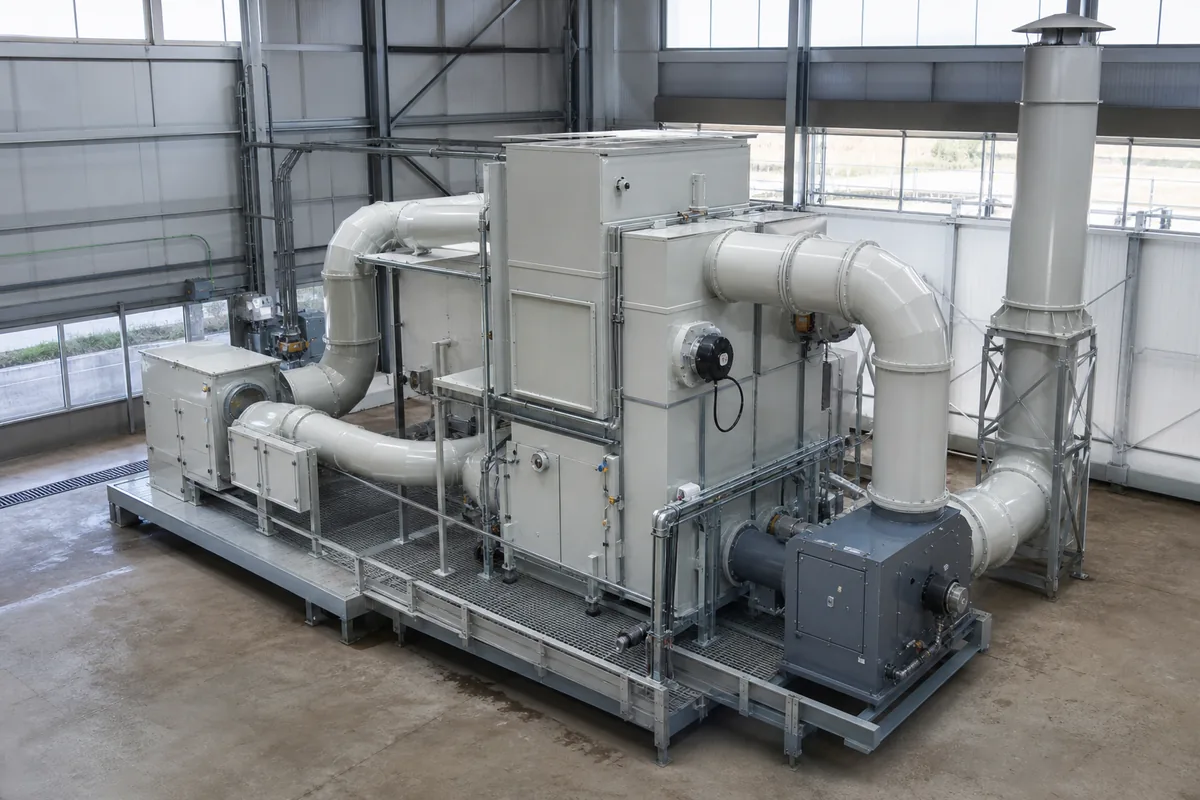
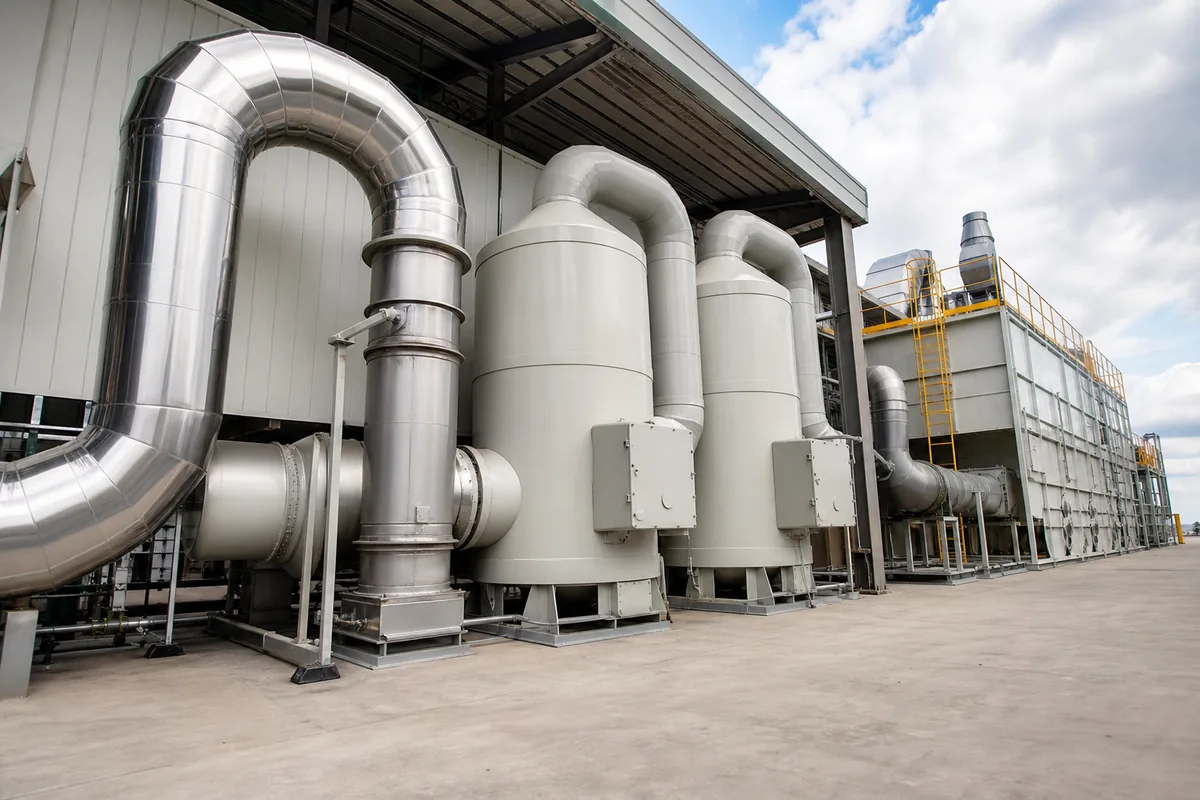
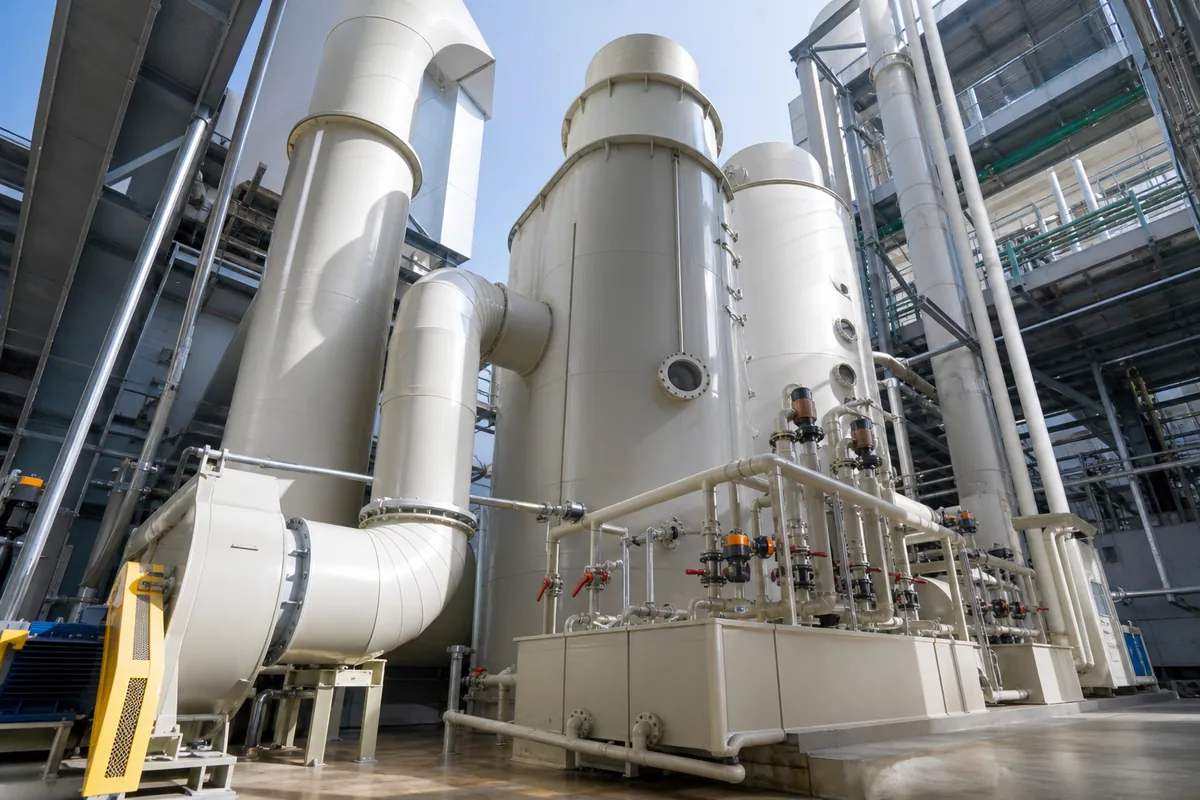
A common arrangement for nitric acid and NOx exhaust is not one tower doing everything. A more stable system uses separate functions:
- Inlet duct and dilution or cooling section, if gas is hot or has high acid concentration.
- First packed stage for HNO₃ mist and acid vapor, usually water or weak alkaline circulation.
- Oxidation stage, either in the duct, reaction tank, or dedicated packed section.
- Alkaline absorption stage for NO₂ and oxidized NOx.
- Mist eliminator, often PP mesh pad or chevron type, to reduce droplet carryover.
- Corrosion-resistant fan, usually placed after the scrubber for negative-pressure operation.
- Stack and sampling port, with enough straight duct for measurement where possible.
For small laboratory or intermittent pickling exhaust, a single PP packed tower with chemical dosing may be acceptable if emission requirements are moderate. For continuous production with high NOx loading, two stages are usually more controllable.
Important mechanical details are often more important than the tower name:
- Use PP, FRP, or other compatible plastics for wetted parts. Check compatibility with oxidant, acid, and temperature together.
- Avoid carbon steel bolts, supports, and instruments in wet acid zones unless they are isolated or protected.
- Install access manholes for packing inspection and cleaning.
- Use a recirculation tank volume large enough to prevent rapid pH and ORP swings. For small systems, a practical minimum is often several minutes of pump flow, but exact volume depends on load variation.
- Provide automatic make-up water and blowdown if dissolved salts will accumulate.
- Select the fan based on total system pressure, not only scrubber pressure.
Why Performance Falls in Real Operation
Many NOx scrubbers perform well during commissioning but lose efficiency later. The causes are usually simple and measurable.
First, the inlet gas may be different from the design basis. Nitric acid concentration, metal loading, bath temperature, ventilation rate, and operating schedule all affect NOx generation. If the process changes from occasional use to continuous use, the scrubber may be undersized.
Second, oxidation control may be poor. Too little oxidant leaves NO untreated. Too much oxidant can create safety problems, chemical odor, wastewater issues, and material stress. ORP probes also foul, drift, or fail. They need cleaning and calibration.
Third, liquid distribution may be uneven. A packed bed needs full wetting. Blocked spray nozzles, low pump flow, or tilted packing support can create dry paths. Gas then bypasses the liquid film and outlet NOx increases.
Fourth, operators may only control pH. pH is important for acid neutralization, but it does not prove that NO has been oxidized. For NOx service, pH control alone is usually not enough.
Recommended operating checks:
- Record inlet and outlet NOx during stable production, not only at idle condition.
- Check pH, ORP, circulation flow, pressure drop, and tank level daily for critical systems.
- Inspect spray nozzles and mist eliminator for salt scaling.
- Compare fan current and duct static pressure with commissioning values.
- Analyze blowdown for nitrate, nitrite, chloride, and oxidant-related species if wastewater limits apply.
A useful rule: if pressure drop rises and flow falls, suspect scaling or blocked packing. If pressure drop is normal but outlet NOx rises, suspect chemistry, gas composition, or poor liquid distribution.
Practical Next Step
Before asking for a guaranteed nox scrubber efficiency, prepare a clear design basis. At minimum, collect:
- Gas flow rate, normal and maximum, in m³/h
- Gas temperature and humidity
- HNO₃ mist or vapor concentration
- NO and NO₂ concentrations separately, if possible
- Operating schedule and peak conditions
- Required outlet limit and measurement method
- Available chemicals and wastewater restrictions
- Existing duct size, fan data, and installation space
With these data, a scrubber supplier can select a realistic process: single-stage acid mist removal, oxidation plus absorption, or multi-stage treatment. This avoids under-design and also avoids adding unnecessary equipment where the inlet gas does not require it.