Why Commissioning Is More Than a Start Button
A wet scrubber can look correct in the workshop and still fail on site if air volume, liquid flow, dosing, drainage, or controls are not verified. For buyers, the commissioning stage is the last chance to confirm that the supplied equipment matches the process duty before final sign-off.
A good scrubber commissioning checklist should answer five questions:
- Is the gas actually entering the scrubber at the design flow and pressure?
- Is the scrubbing liquid reaching the packing or spray zone evenly?
- Are chemical dosing, pH/ORP control, and blowdown working correctly?
- Are the fan, ducting, pumps, instruments, and interlocks operating as one system?
- Is there enough operating data for the plant team to take over safely?
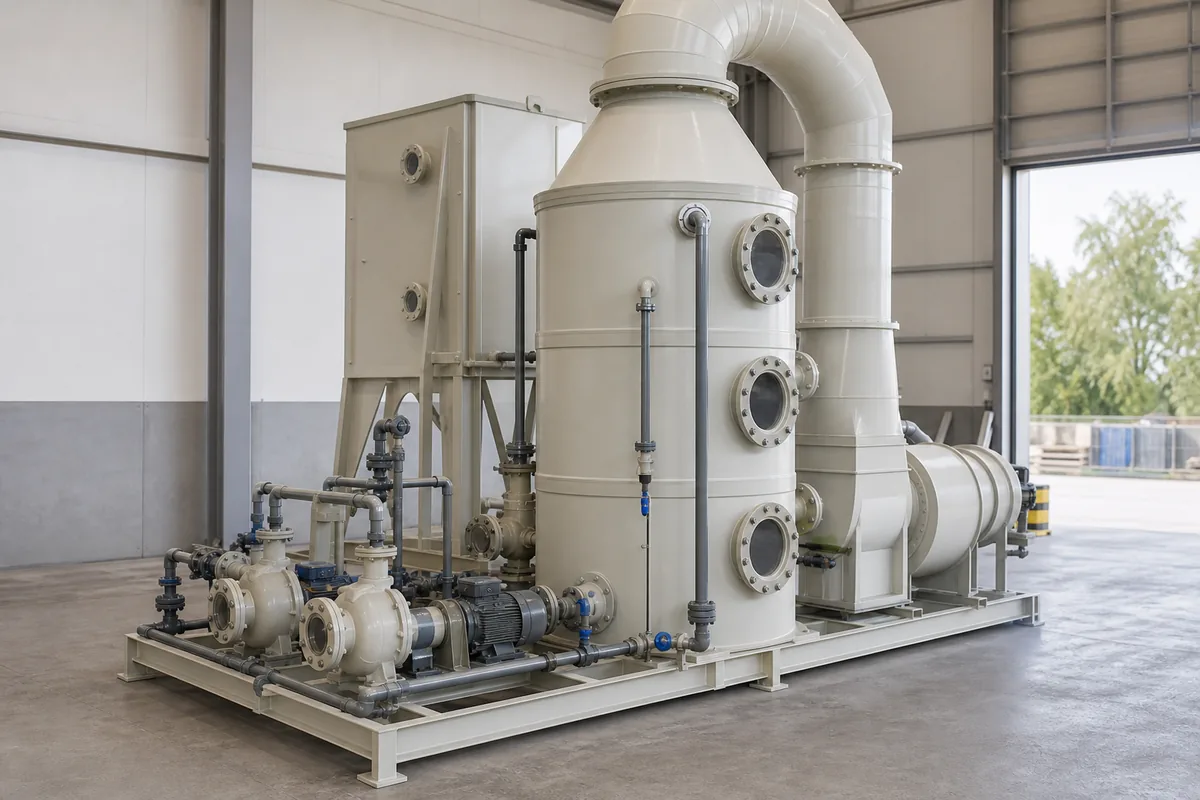
The exact checks depend on whether the scrubber is used for acid gas, alkali gas, odor, soluble VOC, or dust-containing exhaust. However, the basic verification method is similar for most PP packed tower scrubbers, horizontal scrubbers, and multi-stage wet scrubber systems.
Mechanical and Installation Checks Before Water Operation
Before adding water or chemicals, confirm the mechanical installation. Many commissioning problems come from simple site issues such as reversed fan rotation, blocked drains, or unsupported ducting.
Key items to inspect:
- Tower verticality: For vertical packed towers, check that the shell is upright. A visible tilt can cause uneven liquid distribution.
- Flanges and gaskets: PP flanges should be aligned without forcing. Over-tightening may deform the flange face. Tighten bolts evenly in a cross pattern.
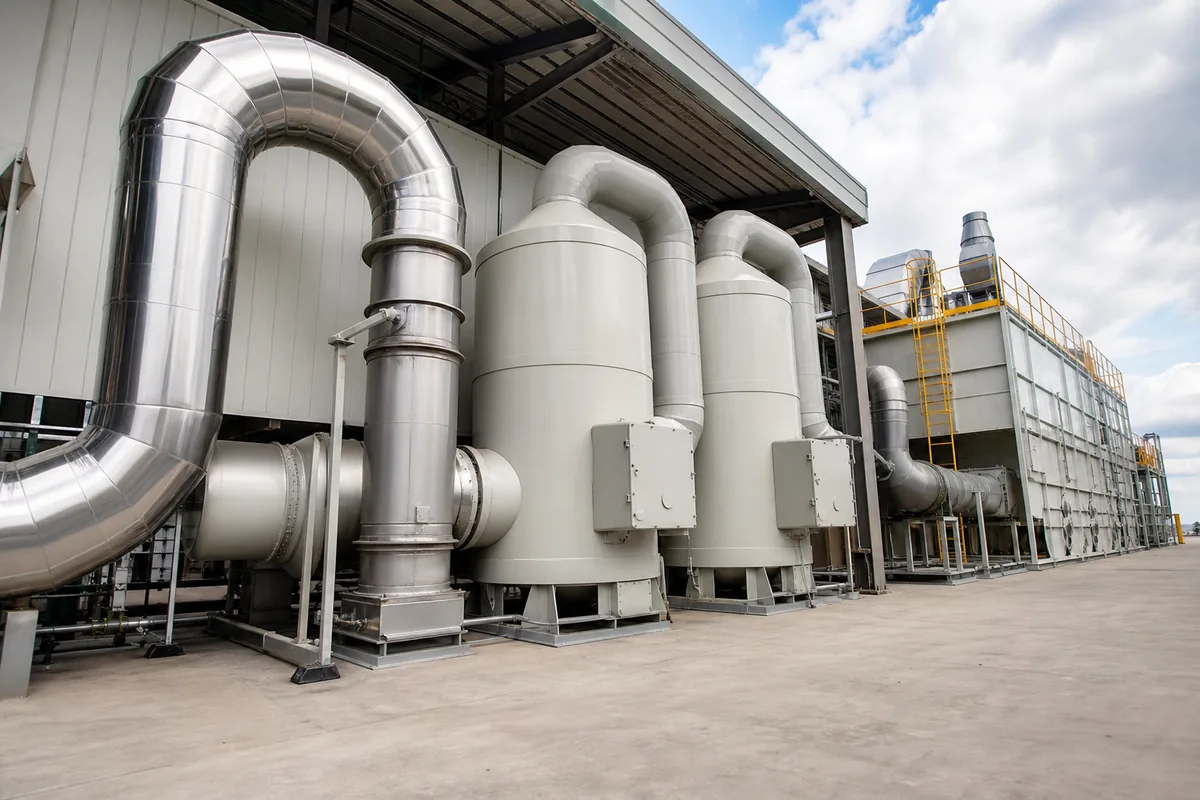
- Duct support: Do not let duct weight hang on the scrubber inlet, outlet, fan casing, or demister section.
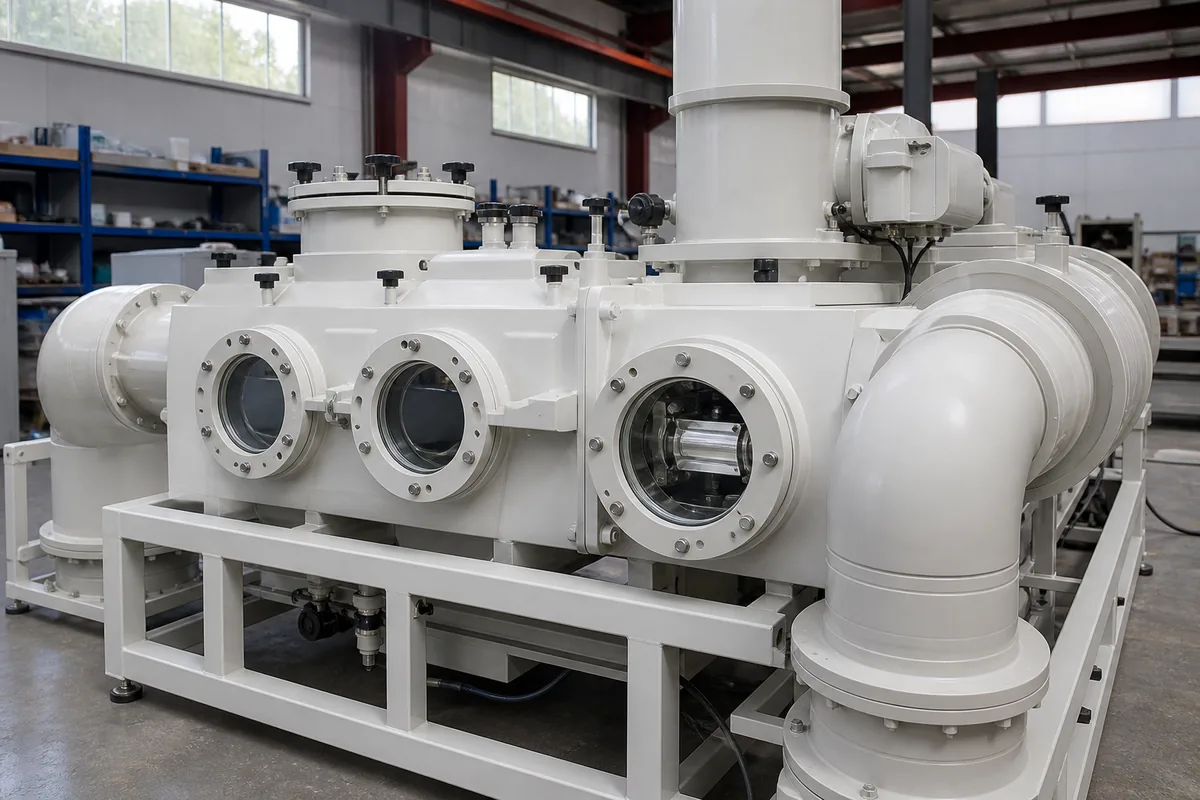
- Access doors and inspection ports: Confirm all covers are sealed and reachable for maintenance.
- Drain and overflow: Fill with clean water and confirm drainage direction. No liquid should remain trapped in low duct sections.
- Packing support plate: Check that packing has not fallen through or been crushed during transport.
- Demister installation: Mist eliminator layers must be installed in the correct direction if the design is directional.
- Fan rotation: Jog the fan motor briefly and confirm rotation direction from the fan arrow.
For PP scrubbers, thermal expansion is also important. Long PP duct runs should have flexible connectors or expansion arrangements. A rule of thumb is that PP expands about 0.1–0.15 mm per meter per °C. A 20 m duct with a 30°C temperature change can move about 60–90 mm, so fixed supports must be designed carefully.
Water, Pump, and Hydraulic Verification
After mechanical checks, run the scrubber with clean water before adding chemicals. This reduces risk and allows the team to find leaks, pump problems, or spray blockage.
Typical checks include:
| Item to verify | Common method | Typical target or warning sign |
|---|---|---|
| Recirculation pump flow | Flowmeter, pump curve, or calibrated tank test | Usually 5–20 m³/h per m² of tower cross-section, depending on duty |
| Spray nozzle condition | Visual inspection through access port | Full cone or designed spray pattern, no dry zone |
| Liquid level | Level gauge or sight tube | Stable level during operation, no vortex at pump suction |
| Pressure drop | Differential pressure gauge | Often 500–1500 Pa for packed tower; higher if mist eliminator or packing is fouled |
| Leak check | Visual inspection | No leakage at flanges, welds, drains, or pump seals |
| Overflow and drain | Open valve test | Free flow to treatment or collection system |
For packed scrubbers, liquid distribution is critical. Uneven wetting creates “dry channels” where gas passes with little contact. If the tower has transparent inspection windows or removable ports, check spray coverage during clean-water testing.
If no flowmeter is installed, a simple pump flow estimate can be made by timing how long it takes to fill a known volume:
Flow (m³/h) = Volume (m³) ÷ Time (seconds) × 3600
For example, if the pump fills a 0.5 m³ test tank in 180 seconds:
0.5 ÷ 180 × 3600 = 10 m³/h
This is not as accurate as a calibrated meter, but it is useful during site commissioning.
Also verify pump suction conditions. For PP scrubber systems, many circulation pumps are installed near the tank bottom. The suction line should be short and not undersized. Air entering the suction line will cause unstable flow, noise, vibration, and poor scrubbing performance.
Airflow, Fan, and Pressure Balance
A scrubber does not work at design efficiency if the exhaust air volume is far from design. Too little air may indicate duct blockage, closed dampers, or wrong fan speed. Too much air can reduce gas-liquid contact time, increase mist carryover, and overload the packing.
Important airflow checks:
- Measure airflow at stack, duct traverse point, or equipment inlet where practical.
- Compare measured flow with design flow, usually in m³/h or Nm³/h.
- Record static pressure at fan inlet, fan outlet, scrubber inlet, and scrubber outlet.
- Confirm damper positions and mark the normal operating position.
- Check vibration and noise after the fan reaches stable speed.
A common engineering rule is to allow a commissioning tolerance of about ±10% on airflow, if the process can accept it. For stricter emission control or narrow process windows, the tolerance may need to be smaller. This must be agreed during technical review.
For centrifugal fans, remember that speed changes affect performance strongly:
- Flow is proportional to speed:
Q₂/Q₁ = N₂/N₁ - Pressure is proportional to speed squared:
P₂/P₁ = (N₂/N₁)² - Power is proportional to speed cubed:
kW₂/kW₁ = (N₂/N₁)³
If a variable frequency drive increases fan speed by 10%, the power demand may increase by about 33%. Check motor current carefully before increasing speed.
Pressure drop is another key sign. A packed tower with very low pressure drop may have low airflow, missing packing, bypass leakage, or insufficient liquid flow. A pressure drop much higher than expected may mean overloaded airflow, flooded packing, blocked demister, excess solids, or undersized ducting.
Chemical Dosing, Instruments, and Control Logic
For acid or alkaline gas scrubbing, water alone is usually not enough. Chemical concentration and control response must be verified before sign-off.
Typical control checks include:
- pH probe calibration: Use at least two buffer solutions, commonly pH 4.00 and 7.00 or pH 7.00 and 10.00, depending on operating range.
- ORP probe calibration or verification: Required for oxidation/reduction systems, such as some chlorine or sulfide applications.
- Dosing pump stroke and frequency: Confirm actual chemical feed rate, not only the setting on the display.
- Interlocks: Low tank level should stop the circulation pump or alarm. High level should alarm or open drain logic if designed.
- Make-up water valve: Confirm automatic filling works and does not cause overflow.
- Blowdown valve: Confirm manual or automatic blowdown path is open and labelled.
- Emergency stop: Test fan and pump shutdown response according to site procedure.
Operating pH depends on the contaminant. Typical starting points are:
| Gas type | Common scrubbing solution | Typical pH control range | Notes |
|---|---|---|---|
| HCl, HF, SO₂ acid gas | NaOH solution | pH 8.5–10.5 | Higher pH improves neutralization but increases chemical use |
| NH₃ alkaline gas | Dilute acid solution | pH 3–6 | Acid selection depends on wastewater limits and site rules |
| H₂S odor | Alkali plus oxidant | Often pH 9–11, ORP controlled | ORP target depends on oxidant and process |
| Soluble VOC | Water or chemical solution | Application-specific | Many VOCs are poorly soluble; adsorption or oxidation may be needed |
Do not set chemical dosing only by theory. The inlet gas concentration, gas flow, liquid volume, reaction speed, and wastewater discharge limits all affect the final setting. During commissioning, record pH or ORP trend under real production load. A stable reading is more useful than a single measurement.
For plants buying a scrubber package, ask the supplier to provide an instrument list showing range, material, power supply, signal type, and installation location. For example, a pH probe in a stagnant corner of the tank will not control correctly. It should be installed where liquid is well mixed and maintenance access is possible.
Performance Sign-Off and Handover Records
Final sign-off should be based on recorded operating data, not only visual inspection. Even if formal emission testing is arranged separately by the owner or a third party, the scrubber supplier and plant team should agree on basic commissioning records.
A practical handover package should include:
- Equipment model, design airflow, and design pressure drop
- Fan motor power, voltage, current, speed, and rotation direction
- Pump model, motor current, flow estimate, and discharge pressure if available
- Scrubber differential pressure under normal airflow
- Recirculation tank level range and make-up water function
- pH/ORP setpoints, alarm values, and calibration record
- Dosing chemical name, concentration, and dosing pump setting
- Photos of installed packing, demister, nozzles, instruments, and control panel
- Alarm and interlock test record
- Recommended routine inspection frequency
For early operation, daily checks are recommended during the first 1–2 weeks. After stable operation, many plants move to weekly inspection for pumps, nozzles, and pH calibration checks, plus monthly inspection of packing and demister condition. Dirty or dusty exhaust may need shorter intervals.
A useful sign-off rule is: run the scrubber under normal production load for at least 2–4 continuous hours, or longer if the process is batch-type. During this time, record airflow, pressure drop, pH/ORP, pump current, fan current, liquid level, and any alarms. If the process has strong concentration peaks, commissioning should include at least one peak condition where safe and practical.
Practical Next Step
Before placing an order or accepting delivery, ask the supplier for a project-specific scrubber commissioning checklist with design values already filled in: airflow, pressure drop, pump flow, liquid volume, chemical setpoints, alarm points, and inspection items. This document helps your team compare actual site readings with the intended design and makes final sign-off clear for both buyer and supplier.