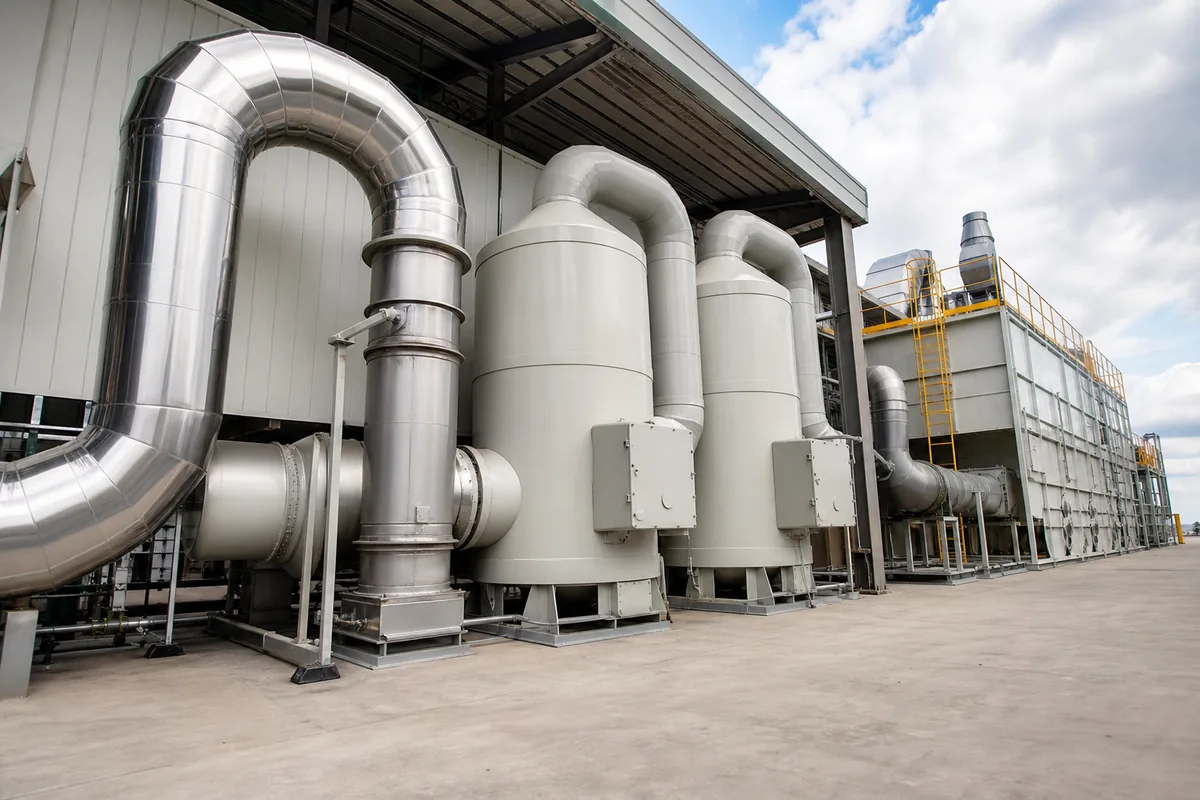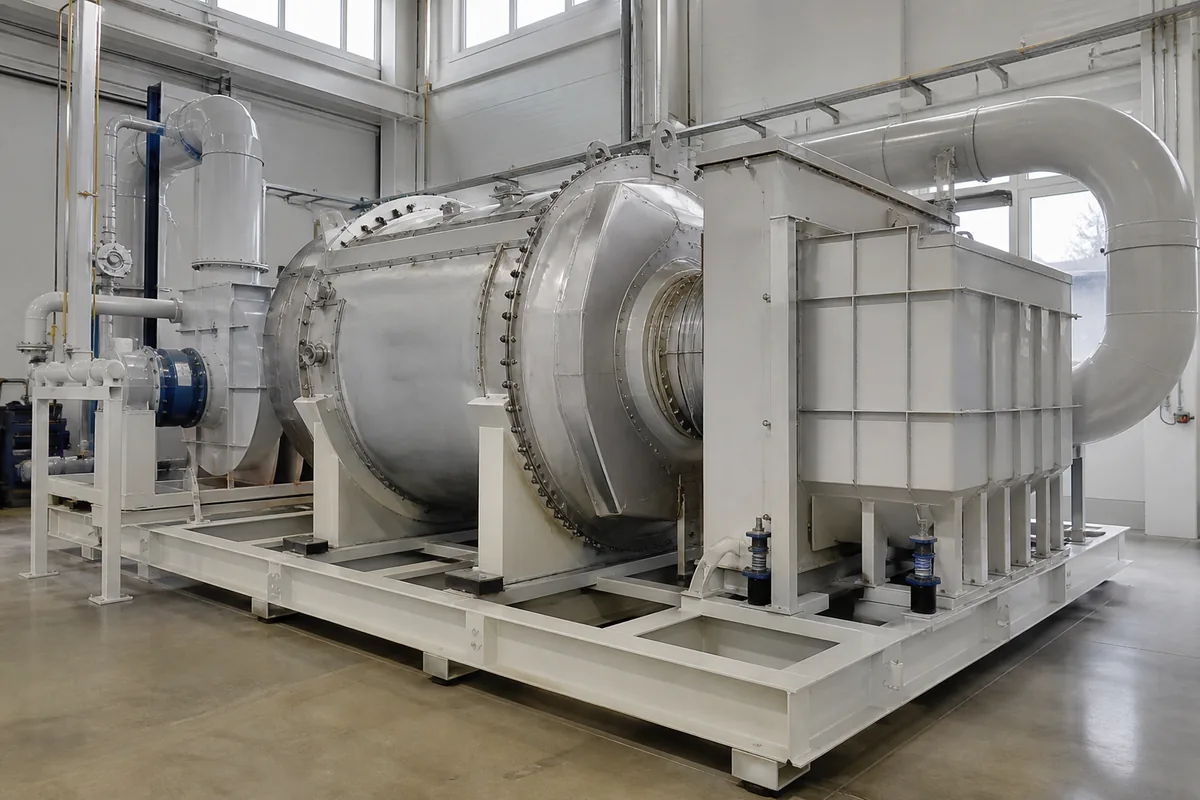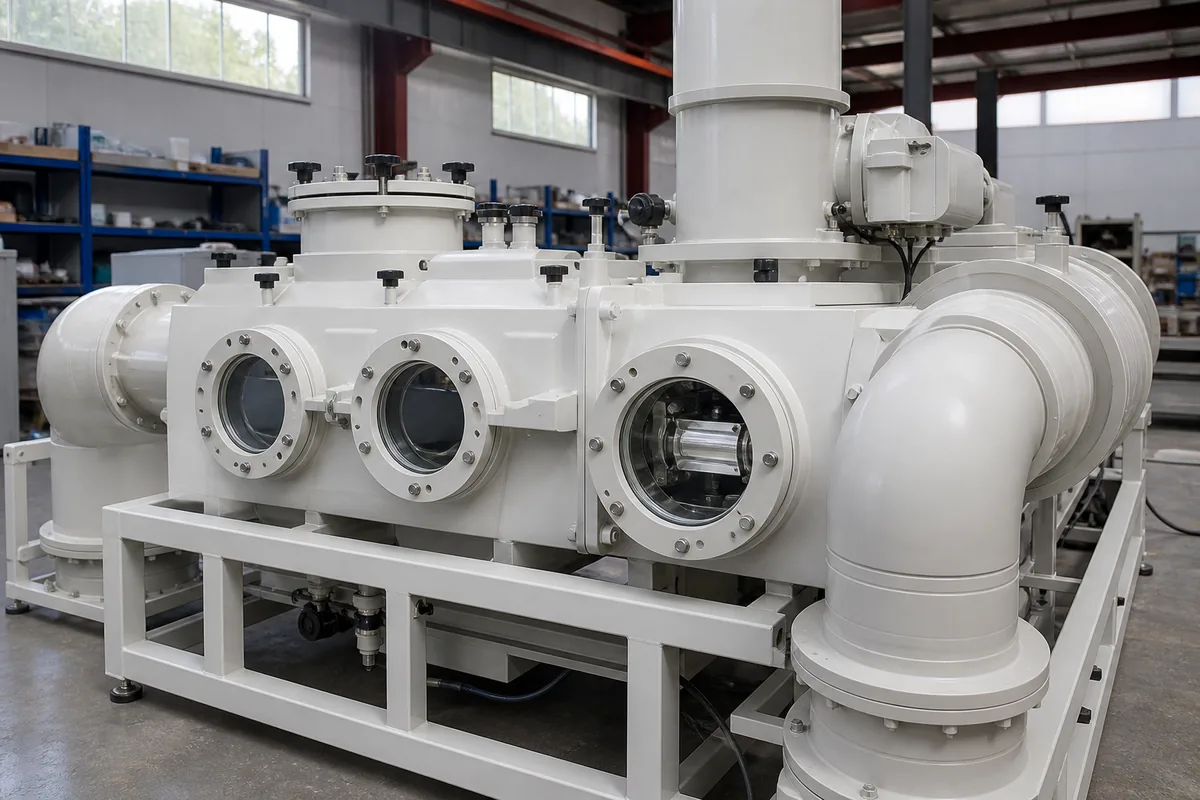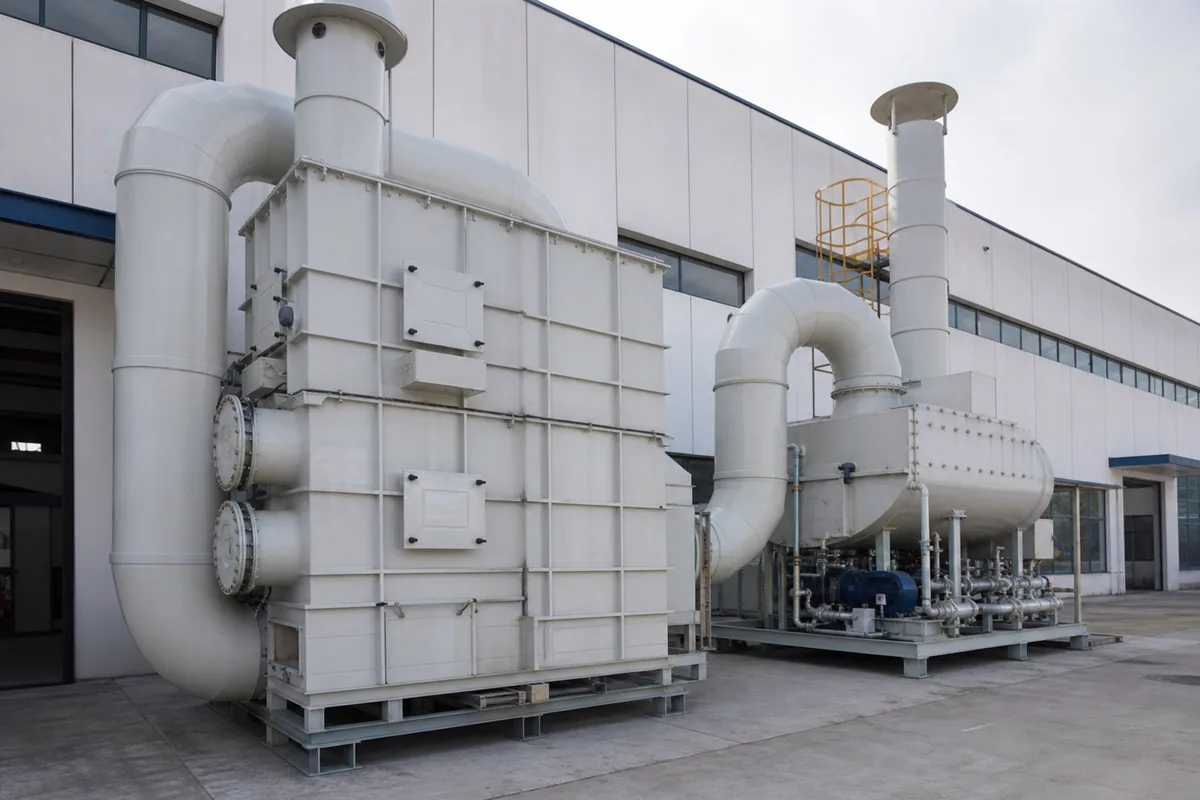
The Basic Difference in Operating Principle
When engineers compare rto vs catalytic oxidizer systems, the first point is temperature. Both destroy VOCs by oxidation, but they do it in different temperature windows.
A regenerative thermal oxidizer (RTO) uses high temperature, usually 760–850°C, to oxidize VOCs into CO₂ and H₂O. Heat is recovered through ceramic media beds. A typical 2-bed or 3-bed RTO can reach 90–95% thermal efficiency, and some designs can be higher depending on valve sealing, bed depth, airflow stability and insulation quality.
A catalytic oxidizer uses a catalyst to lower the VOC oxidation temperature. Typical operating temperature is 250–450°C, depending on VOC type and catalyst formulation. Heat recovery is usually by a gas-to-gas heat exchanger, often with 50–75% thermal efficiency. Some catalytic systems also use regenerative beds, but in many industrial packages the fixed-bed catalytic design is more common.
The simplified oxidation reaction is:
`text VOC + O₂ → CO₂ + H₂O + heat `
The “heat” part is important. If the VOC concentration is high enough, both systems can operate with little or no auxiliary fuel after start-up. This point is often called the autothermal point.
As a rough rule:
- RTO autothermal operation is often possible at around 1.5–2.5 g/Nm³ VOC, depending on VOC heat value and RTO efficiency.
- Catalytic oxidizer autothermal operation may be possible at around 0.8–1.5 g/Nm³ VOC, because of the lower reaction temperature.
- For low-concentration exhaust, for example <0.5 g/Nm³, fuel consumption becomes a key operating cost for both systems.
These values are only rules of thumb. Actual fuel use depends on exhaust flow, inlet temperature, oxygen content, VOC heat value, heat recovery efficiency, insulation, leakage and operating schedule.
Capex Comparison: Where the Money Goes
For the same airflow, an RTO is usually a larger and heavier system. It needs ceramic heat exchange media, switching valves, combustion chamber, insulation, structural steel, access platforms and a control system to manage bed switching. For high airflow, such as 20,000–100,000 Nm³/h, the RTO size and foundation load become important engineering items.
A catalytic oxidizer often has a smaller reactor volume because the operating temperature is lower and no large ceramic heat storage bed is required in a basic recuperative design. However, the catalyst module itself is a significant cost component. The catalyst must match the VOC composition, temperature, poisons and required destruction efficiency.
A practical comparison is below.
| Item | RTO | Catalytic oxidizer |
|---|---|---|
| Typical oxidation temperature | 760–850°C | 250–450°C |
| Heat recovery | 90–95% typical for regenerative design | 50–75% typical for recuperative design |
| Equipment size | Larger, heavier | Usually smaller |
| Main special component | Ceramic media, valves | Catalyst modules |
| Suitability for variable VOC mixtures | Generally strong | Depends strongly on catalyst compatibility |
| Sensitivity to catalyst poisons | Not applicable | High |
| Start-up energy | Higher due to mass and temperature | Lower |
| Maintenance focus | Valves, media, burners, insulation | Catalyst condition, heat exchanger, burner |
| Practical airflow range | Very wide, good for large flows | Common for small to medium flows; large flows possible but catalyst cost rises |
In many projects, the installed cost is not decided by the oxidizer alone. Ducting, exhaust fan, explosion protection design, pre-filtration, stack, platform, PLC system, civil foundation and site installation can be a large part of total investment.
For procurement comparison, always request the same scope from suppliers:
- Design airflow in Nm³/h and maximum operating airflow
- VOC name, concentration and fluctuation range
- Inlet gas temperature and humidity
- Required destruction/removal efficiency
- Heat recovery scope
- Fan, ducting, stack and platform included or excluded
- Electrical control and instrumentation scope
- Materials of construction for corrosive gas sections
- Site installation and commissioning responsibilities
Without a unified scope, an “RTO quotation” and a “catalytic oxidizer quotation” may not be comparable.
Opex: Fuel, Electricity, Maintenance and Downtime
Operating cost is usually dominated by four items: auxiliary fuel, fan power, consumable replacement and maintenance downtime.
Fuel demand can be estimated from the heat balance. A simplified heating duty is:
`text Q = Flow × Gas density × Cp × ΔT × (1 - heat recovery efficiency) `
Where:
Flow= exhaust flow, m³/sGas density≈ 1.2 kg/m³ at ambient conditionCp≈ 1.0 kJ/kg·K for airΔT= temperature rise required, K
Example for 10,000 Nm³/h exhaust at 25°C:
For an RTO operating at 800°C with 95% heat recovery:
`text Flow = 10,000 / 3,600 = 2.78 m³/s ΔT = 800 - 25 = 775 K Q = 2.78 × 1.2 × 1.0 × 775 × (1 - 0.95) Q ≈ 129 kW before VOC heat contribution `
For a catalytic oxidizer operating at 350°C with 65% heat recovery:
`text ΔT = 350 - 25 = 325 K Q = 2.78 × 1.2 × 1.0 × 325 × (1 - 0.65) Q ≈ 379 kW before VOC heat contribution `
This example shows an important point: although the catalytic oxidizer operates at lower temperature, its lower heat recovery may result in higher fuel demand than an efficient RTO. If the catalytic unit uses better heat recovery, or if the VOC concentration is suitable, the result can change. Do not compare only oxidation temperature.
Electricity consumption mainly comes from pressure drop. Typical clean pressure drop ranges are:
- RTO: 2,000–4,500 Pa, depending on ceramic bed depth, valves and ducting
- Catalytic oxidizer: 1,000–3,000 Pa, depending on catalyst cell density, heat exchanger and ducting
- Pre-filter or mist eliminator: often 300–1,500 Pa, and higher if dirty
Fan power can be estimated by:
`text Fan power kW = Flow m³/s × Pressure Pa / (1000 × fan efficiency) `
For 10,000 Nm³/h, 3,000 Pa total pressure and 65% fan efficiency:
`text Power = 2.78 × 3000 / (1000 × 0.65) ≈ 12.8 kW `
Maintenance cost differs by technology. RTO valves must seal well and switch reliably. Poor valve sealing can reduce destruction efficiency and increase fuel use. Ceramic media can plug if the gas contains resin, dust, tar, silicon oil mist or high-boiling condensables.
Catalytic oxidizers require periodic catalyst inspection. Catalyst life can be several years in clean service, but it can be much shorter if the gas contains poisons or masking agents. Replacement planning is necessary, especially for continuous production lines where shutdown time is limited.
Practical Limits and Risk Factors
The best choice is often decided by what is in the gas, not only by airflow and VOC concentration.
Catalytic oxidizers have strict limits for catalyst poisons. Common problem substances include:
- Organic or inorganic silicon compounds
- Phosphorus, sulfur and heavy metals
- Halogenated compounds such as chlorinated solvents
- High dust loading, sticky aerosol or resin mist
- High-boiling VOCs that condense before reaching reaction temperature
Some sulfur or halogen compounds may be technically treatable, but they can form acidic gases after oxidation. Then downstream acid gas control, such as a PP wet scrubber, may be required. Materials must be selected carefully because HCl, HF, SO₂ or SO₃ can cause corrosion.
RTOs are generally more tolerant of mixed VOCs and catalyst poisons because there is no catalyst. However, they are not universal. Practical RTO limits include:
- High solvent concentration approaching the lower explosive limit (LEL)
- Sticky particulate that can plug ceramic media
- Organic silicon that oxidizes to SiO₂ and deposits in the media
- Halogenated VOCs requiring corrosion-resistant downstream treatment
- Very intermittent operation, where repeated heat-up and cool-down wastes fuel
For safety, many systems design normal VOC concentration below 25% LEL, and some applications use lower limits depending on local rules and risk assessment. If concentrations can spike, LEL monitoring, dilution air, bypass logic or upstream process control may be needed.
Temperature also matters. If exhaust temperature is near the dew point of solvents, condensation in ducts can create fire, corrosion and maintenance risks. Duct velocity is commonly kept around 10–18 m/s for VOC exhaust, but it depends on duct diameter, pressure drop and whether mist or particles are present.
For high humidity exhaust, the water vapor increases gas volume and heat load. For corrosive wet gas, PP ducting, FRP sections, stainless steel or lined steel may be considered depending on temperature and chemical composition. PP is not suitable for high-temperature oxidizer zones, but it can be suitable for cool corrosive ducting and scrubber sections.
Selection Rules of Thumb
For a first screening, the following rules are useful.
Choose an RTO when:
- Airflow is medium to large, for example >10,000–15,000 Nm³/h
- VOC concentration is low to medium but continuous
- VOC mixture changes often
- Catalyst poisoning risk is unclear or high
- High thermal efficiency is important
- The plant can accept larger equipment and higher weight
Choose a catalytic oxidizer when:
- VOC composition is stable and catalyst-compatible
- Flow is small to medium
- Start-up time and lower operating temperature are important
- Exhaust is clean, dry enough and well filtered
- Catalyst replacement can be planned without major production loss
- The required destruction efficiency can be achieved at the selected temperature and residence time
Neither technology should be selected from airflow alone. For example, a 5,000 Nm³/h stream with clean toluene at stable concentration may suit a catalytic oxidizer. A similar flow containing silicone additives from coating or printing may be a poor catalytic application and may need RTO or another treatment route. A 50,000 Nm³/h low-concentration stream may suit an RTO, but if operation is only two hours per day, fuel use during each start-up may make concentration, adsorption or process modification more attractive.
In some plants, a combined system is better. Activated carbon adsorption can concentrate low-level VOCs before oxidation. A wet scrubber can remove acid gases after oxidation. A demister or filter can protect the oxidizer from droplets and solids. These auxiliary systems often determine long-term reliability.
Practical Next Step
Before deciding rto vs catalytic oxidizer, prepare one gas data sheet for each exhaust source. Include airflow, temperature, humidity, VOC names, average and peak concentration, dust/mist content, halogens, sulfur, silicon compounds, operating hours and required removal efficiency.
With this data, ask suppliers to provide:
- Heat balance with assumed VOC calorific value
- Estimated auxiliary fuel use at average and low VOC concentration
- Total pressure drop and fan power
- Maintenance items and expected replacement parts
- Required pre-treatment and downstream treatment
- Materials of construction for each gas-contact section
A correct comparison is not “which oxidizer is better,” but which system is safer, more stable and lower cost over the operating life for your actual exhaust gas.