Why Plants Consider PP When an FRP Scrubber Reaches End of Life
When an existing FRP scrubber is cracked, leaking, delaminating, or difficult to maintain, many plants compare replacement materials before ordering a new unit. The common question is frp vs pp scrubber: what really changes if the new scrubber is made from polypropylene instead of fiberglass reinforced plastic?
Both FRP and PP can work well in corrosive exhaust treatment. The right choice depends on gas composition, liquid chemistry, temperature, pressure, mechanical load, installation area, and maintenance style. PP is not a direct “same in every way” replacement for FRP. It changes the fabrication method, corrosion behavior, repair method, structural design, and sometimes the layout.
This article explains the main engineering differences that matter when replacing an FRP wet scrubber with a PP wet scrubber.
Material Behavior: Corrosion, Temperature, and Aging
FRP is a composite material. It normally has a resin-rich corrosion barrier inside and fiberglass reinforcement behind it. Chemical resistance depends strongly on the resin type, liner thickness, glass quality, and fabrication quality.
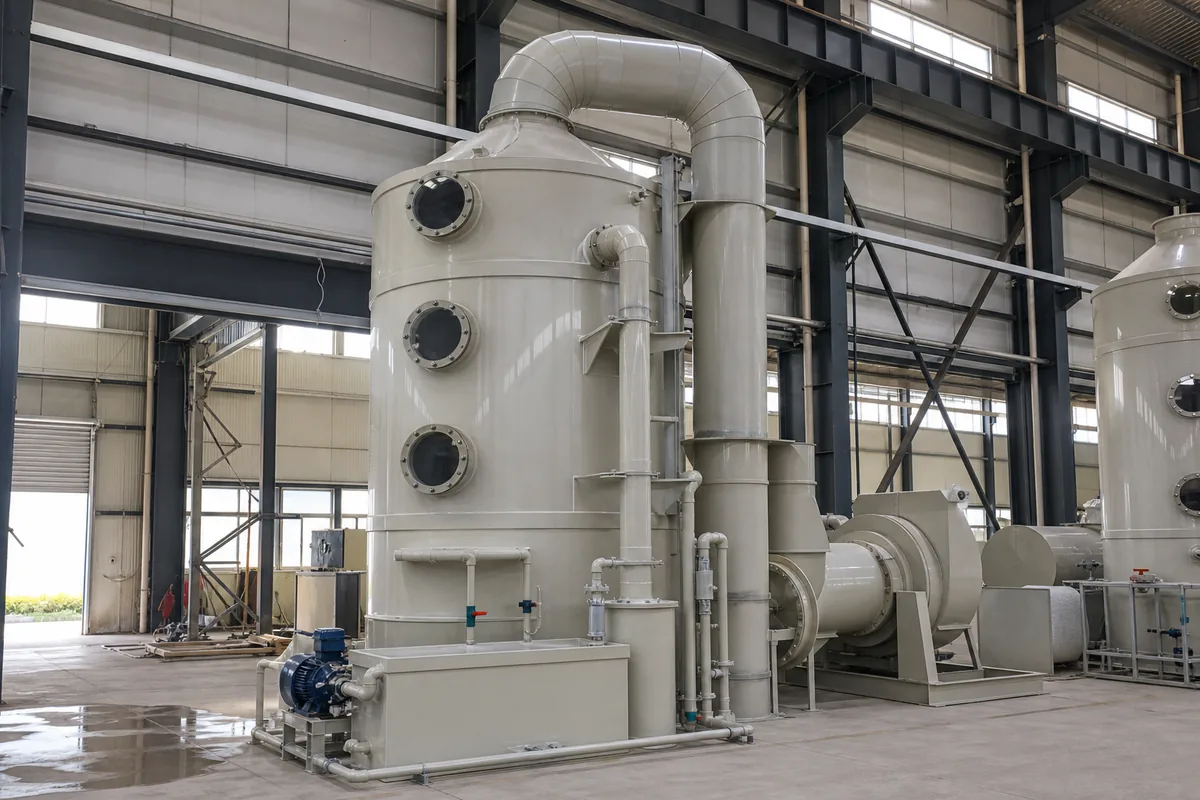
PP is a thermoplastic. In scrubbers, it is usually supplied as solid PP sheet, PP-H sheet, or reinforced PP structure, fabricated by hot gas welding or extrusion welding. The whole wall thickness is corrosion-resistant PP, not only an inner liner.
Typical operating limits are different:
| Item | FRP Scrubber | PP Scrubber |
|---|---|---|
| Main material | Resin + glass fiber reinforcement | Solid polypropylene sheet |
| Typical continuous temperature range | Often 60–100°C, resin-dependent | Commonly 0–80°C, design-dependent |
| Short-term temperature tolerance | Can be higher with suitable resin | Usually limited; avoid softening |
| Resistance to acids/alkalis | Good with correct resin | Very good for many acids and alkalis |
| Solvent resistance | Resin-dependent; some solvents attack resin | Poor to moderate for many organic solvents |
| UV resistance outdoors | Needs suitable resin/gel coat or coating | Needs UV-stabilized sheet or protection |
| Repair method | Grinding, lamination, curing | Plastic welding with PP rod/sheet |
| Failure mode | Cracking, blistering, delamination | Welding crack, deformation, creep |
For acid and alkaline gas treatment, PP is often attractive because it has strong resistance to many common scrubber chemicals:
- HCl and chloride-containing mist
- HF at suitable concentration and temperature
- H₂SO₄ mist in many dilute to medium concentration conditions
- NaOH scrubbing liquor
- NaClO or oxidizing liquid at controlled concentration and temperature
However, do not select PP only by gas name. Always check:
- Liquid concentration and operating temperature
- Possible solvent carryover
- Oxidizer concentration, such as sodium hypochlorite or hydrogen peroxide
- Peak temperature during upset conditions
- Whether hot gas may enter during fan failure or pump failure
As a rule of thumb, PP wet scrubbers are commonly designed for gas temperatures below 70–80°C at the scrubber inlet after quenching or dilution. If the process exhaust can exceed this, include a quench tower, dilution air, interlock, or choose another material.
Structural Design Changes When Moving from FRP to PP
FRP is relatively stiff because fiberglass provides reinforcement. PP is more flexible and has lower stiffness, especially at higher temperature. This affects the body, support frame, nozzles, duct connections, and packing support.
A PP scrubber usually needs more attention to:
- External steel or PP-reinforced frames
- Ring stiffeners for vertical towers
- Flat panel reinforcement for rectangular scrubbers
- Nozzle reinforcement pads
- Flanged duct support close to the scrubber
- Pump and piping supports independent from the scrubber wall
PP also has a higher thermal expansion than FRP. A useful rule of thumb for PP is:
`text Thermal expansion ≈ 0.10 to 0.15 mm/m/°C `
Example: for a 3 m high PP scrubber with a 40°C temperature change:
`text Expansion ≈ 3 m × 40°C × 0.12 mm/m/°C = 14.4 mm `
This is not negligible. Ducts, platforms, and pipework should allow movement. Do not rigidly connect a PP scrubber between fixed steel ducts without flexible connections or expansion allowance.
Wall thickness depends on diameter, height, temperature, internal pressure, wind load, platform load, and fabrication method. Common PP sheet thicknesses used in scrubber fabrication include 8, 10, 12, 15, 20, and 25 mm. Small vertical towers may use thinner sheets; large towers or rectangular units need thicker panels and reinforcement.
Negative pressure is another key point. Wet scrubbers often operate under suction from an induced draft fan. A typical operating pressure may be -500 to -2500 Pa, but blockage or closed dampers can create higher vacuum. PP vessels can deform if vacuum design is weak. When replacing FRP, confirm the maximum fan static pressure and possible blocked-in condition.
Process Performance: Usually Similar, but Internals May Change
Changing from FRP to PP does not automatically change scrubbing efficiency. Efficiency depends more on gas-liquid contact, residence time, packing height, liquid flow, droplet removal, and chemistry.
If the old FRP scrubber performed well, the PP replacement can usually keep similar process parameters:
`text Gas velocity in packed tower: commonly 1.0–2.5 m/s Liquid-to-gas ratio: commonly 1–10 L/m³, depending on pollutant Packing height: often 0.8–2.5 m per stage Mist eliminator face velocity: commonly 2–4 m/s Scrubber pressure drop: often 800–2500 Pa for packed systems `
These are only starting ranges. Actual design depends on pollutant type and removal target. For example, HCl absorption in alkaline water can use lower liquid rates than some poorly soluble VOC or oxidizing applications. Ammonia, chlorine, acid mist, and fluoride gas all need different chemical control.
When replacing an existing unit, do not copy only the outside dimensions. Check the original performance problem:
- Was packing fouled or collapsed?
- Was the spray nozzle distribution poor?
- Was the circulation tank too small?
- Was pH control unstable?
- Was the mist eliminator overloaded?
- Was the fan operating point wrong?
- Was there too much dust entering the packed bed?
PP allows easy fabrication of integrated tanks, access doors, spray headers, packing supports, and demister housings. But large access openings require reinforcement because PP is flexible. Manways and inspection windows should be placed where operators can clean nozzles and remove packing without cutting the body.
For most packed PP scrubbers, include these design details:
- Removable spray headers or unions outside the tower
- Packing support strong enough for wet packing weight and scale
- Hold-down grid if gas velocity may lift packing
- Drain slope in the bottom tank
- Overflow, low-level protection, and make-up water connection
- pH and ORP ports if chemical dosing is required
- Differential pressure ports across packing and demister
Installation and Maintenance Differences
One practical advantage of PP is repair simplicity. A trained plastic welder can repair cracks, add small nozzles, or replace local panels by welding compatible PP material. FRP repair requires surface preparation, resin mixing, lamination, curing time, and good humidity/temperature control.
However, PP also needs correct handling. It can be damaged by sharp impact, hot welding sparks from nearby steel work, and unsupported heavy pipes. During installation, avoid using the scrubber shell as a pipe support or platform support.
Compared with FRP, PP scrubbers often require more careful attention to mechanical support:
| Maintenance / Installation Item | What Changes with PP |
|---|---|
| Lifting | Use spreader beams or multiple lifting points to avoid deformation |
| Duct connection | Use flexible connectors or well-aligned flanges |
| Piping | Support chemical and water pipes separately |
| Hot work nearby | Protect PP from sparks and flame |
| Outdoor installation | Consider UV protection and wind reinforcement |
| Cleaning | Avoid hard metal tools that gouge PP surfaces |
| Repair | Use compatible PP welding rod and qualified welding procedure |
PP surfaces are smooth and do not have exposed glass fibers. This helps cleaning in some acid/alkali service. But if scaling occurs, such as calcium salts, silica, or fluoride precipitate, mechanical cleaning is still needed. Design access for cleaning from the beginning.
For circulation systems, PP tanks and PP piping are often used together with plastic or lined pumps. Typical scrubber circulation pump flow can be estimated from:
`text Pump flow (m³/h) = Gas flow (m³/h) × L/G ratio (L/m³) ÷ 1000 `
Example: for 20,000 m³/h gas flow and 3 L/m³ liquid-to-gas ratio:
`text Pump flow = 20,000 × 3 ÷ 1000 = 60 m³/h `
Add margin for nozzle pressure and future fouling, but do not oversize blindly. Excessive liquid flow increases pump power, droplet carryover, and demister load.
Procurement Checks Before Replacing FRP with PP
For a reliable frp vs pp scrubber comparison, procurement should request more than a general quotation. The supplier needs enough process and site data to design the PP unit correctly.
Prepare these data before asking for design:
- Gas flow rate: normal, minimum, and maximum, in actual m³/h
- Gas temperature: normal and maximum upset temperature
- Pollutants: names, inlet concentration, expected outlet requirement
- Dust, mist, oil, or solvent content
- Existing scrubber dimensions, if replacement must fit same area
- Available fan static pressure or fan curve
- Circulation liquid chemistry: pH, concentration, oxidizers, salts
- Required material for packing, demister, pump, and ducting
- Indoor or outdoor installation, wind/seismic/site requirements if applicable
- Access limitations for transport, lifting, and maintenance
Also clarify battery limits. A scrubber package may include only the tower body, or it may include circulation tank, pump, fan, ducting, stack, instruments, dosing system, and control panel. Many replacement problems happen because the old fan, duct, or pump is kept without checking the new pressure drop and hydraulic requirements.
If the old FRP unit failed early, identify the failure cause before copying the design in PP. For example:
- High gas temperature may deform PP unless quenched.
- Solvent vapor may attack PP or packing.
- Poor pH control may cause corrosion of metal accessories.
- Dust may block packing in both FRP and PP scrubbers.
- Strong oxidizers may limit material life if concentration is too high.
Practical Next Step
Before selecting PP, make a one-page comparison using your real operating data: gas flow, temperature, chemicals, pressure drop, and installation layout. Send photos of the existing FRP scrubber, nameplate data if available, and sketches of duct connections. With these details, a supplier can confirm whether PP is suitable, what structural changes are needed, and whether the replacement can keep the same footprint and fan system.