Why Pressure Drop Is a Useful Daily Check
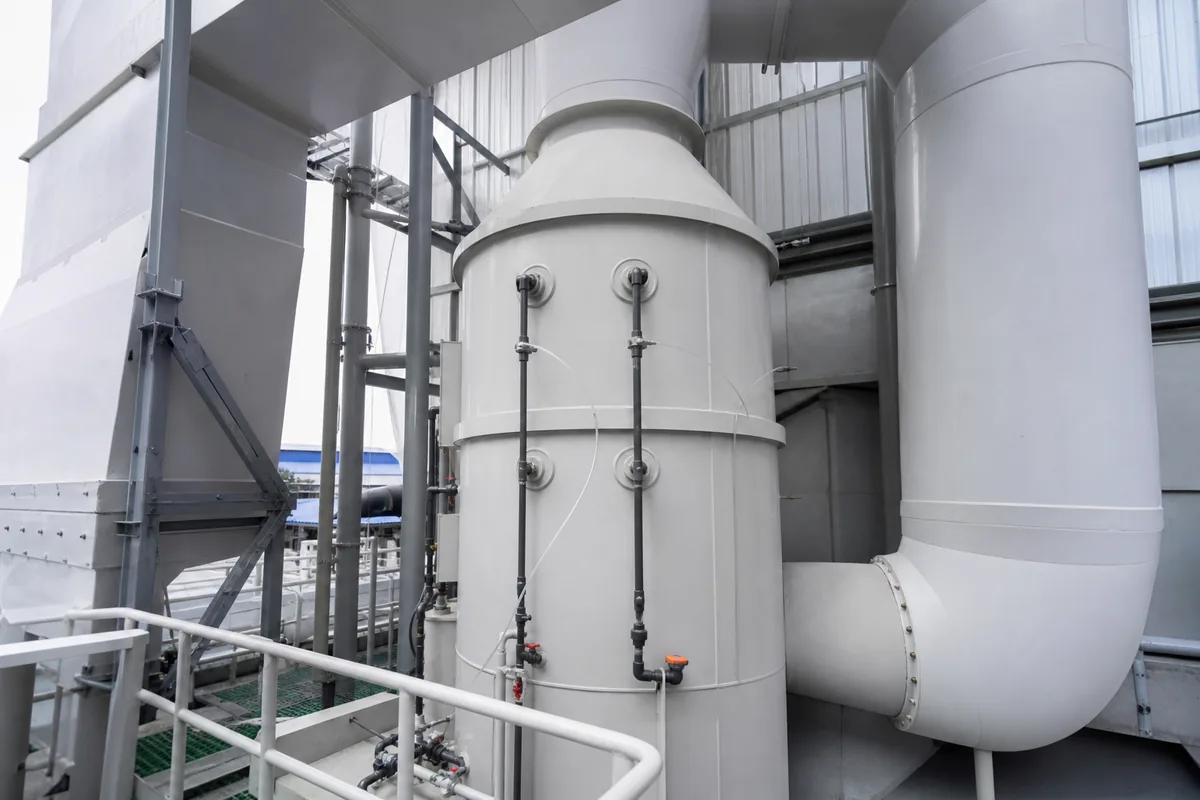
In a packed-bed wet scrubber, scrubber pressure drop is one of the fastest signals for judging whether the system is healthy. It is not the only signal, but it is easy to measure and it reacts quickly to fouling, flooding, mist eliminator blockage, fan problems, and airflow changes.
Pressure drop is the static pressure difference between the scrubber gas inlet and gas outlet. It is normally shown in:
- Pa or kPa
- mmH₂O
- in. w.g.
Rule of thumb: 1 in. w.g. ≈ 249 Pa ≈ 25.4 mmH₂O
For a typical PP packed-bed scrubber, the total pressure drop is often in these ranges:
| Scrubber section | Typical pressure drop range | What affects it |
|---|---|---|
| Inlet duct / transition | 50–200 Pa | Duct velocity, elbows, inlet design |
| Packing bed | 300–1,000 Pa per bed | Packing type, bed height, gas velocity, liquid rate, fouling |
| Mist eliminator | 100–400 Pa clean | Droplet loading, scaling, solids, biological growth |
| Outlet duct / stack connection | 50–200 Pa | Duct layout, damper position |
| Total scrubber | 500–1,800 Pa typical | Depends strongly on design and service |
These are practical ranges, not guaranteed values. A scrubber handling clean acid gas may run below 800 Pa for years. A scrubber treating dusty, sticky, or high-salt gas may run higher and need more frequent cleaning.
The best maintenance signal is not the absolute pressure drop alone. It is the change from the clean baseline at the same airflow and liquid flow.
Build a Correct Baseline First
Before using scrubber pressure drop for maintenance decisions, record a baseline when the scrubber is clean and operating normally. This is usually after commissioning, after packing replacement, or after a full washdown.
Record at least the following:
- Total pressure drop across the scrubber, Pa
- Pressure drop across the packing bed, if separate taps are installed
- Pressure drop across the mist eliminator, if separate taps are installed
- Fan frequency or motor speed
- Airflow, m³/h, if available
- Scrubbing liquid flow rate, m³/h
- Circulation tank level
- pH and conductivity
- Gas temperature
- Damper positions
- Visual condition of spray nozzles, packing, and demister
Pressure drop changes with airflow. For many scrubber components, pressure drop is roughly proportional to the square of gas velocity:
`text ΔP₂ ≈ ΔP₁ × (Q₂ / Q₁)² `
Where:
ΔP₁= baseline pressure dropΔP₂= expected pressure drop at new airflowQ₁= baseline airflowQ₂= new airflow
Example:
A scrubber has a clean pressure drop of 900 Pa at 10,000 m³/h. Later the airflow is increased to 12,000 m³/h.
`text Expected ΔP = 900 × (12,000 / 10,000)² Expected ΔP = 900 × 1.44 = 1,296 Pa `
If the measured value is about 1,300 Pa, this may be normal. If it is 1,800 Pa, fouling or flooding should be checked.
For variable frequency drive fans, always compare pressure drop at similar fan frequency or corrected airflow. Without this correction, maintenance staff may clean a scrubber that is simply running at higher airflow.
How to Read Rising Pressure Drop
A slow increase in scrubber pressure drop usually means material is accumulating inside the gas path. The location depends on where pressure taps are installed.
Common causes include:
- Dust or salt buildup in packing
- Scaling from high hardness water or high dissolved solids
- Blocked spray nozzles causing poor wetting and dry deposits
- Mist eliminator blockage
- Biological slime in warm, nutrient-containing water
- Broken packing pieces settling and restricting flow
- Excessive liquid flow causing loading or flooding
- High inlet particulate loading not removed before the scrubber
Useful warning rules:
| Change from clean baseline | Maintenance meaning | Suggested action |
|---|---|---|
| +10% to +20% | Early change | Check trend, confirm airflow and liquid flow |
| +20% to +40% | Fouling likely | Inspect nozzles, demister, packing top surface |
| +40% to +70% | Serious blockage or flooding possible | Plan shutdown cleaning soon |
| Over +70% | High fan load and poor gas distribution risk | Investigate immediately |
For example, if a scrubber normally runs at 1,000 Pa and slowly rises to 1,300 Pa at the same airflow, this is a 30% increase. It is not an emergency in most systems, but it should trigger inspection. If it rises to 1,700 Pa, the fan may lose airflow, the packing may be partially blocked, and removal efficiency may fall.
A rising pressure drop together with falling airflow is especially important. The fan may still be running, but the system may not capture enough exhaust from process hoods. In this case, check hood capture, duct static pressure, and fan current.
Also look at pH and conductivity. High conductivity often means salts are concentrating in the recirculation liquid. If blowdown is too low, crystals can form in packing and demister sections. A simple operating rule is to control blowdown so conductivity stays within the process limit set during design or operation trials.
How to Read Low or Falling Pressure Drop
A low scrubber pressure drop is not always good. If pressure drop falls without an intentional airflow reduction, it may mean gas is bypassing the active contact zone or liquid distribution is poor.
Possible causes include:
| Symptom | Possible cause | Field check |
|---|---|---|
| Total pressure drop falls, fan speed unchanged | Lower airflow due to upstream damper change or duct leak | Measure duct velocity or check damper positions |
| Packing pressure drop falls | Packing bed has collapsed or gas bypass path has formed | Open inspection port during shutdown |
| Mist eliminator pressure drop falls | Demister missing, damaged, or not seated | Inspect demister frame and seals |
| Pressure drop low and outlet odor high | Poor gas-liquid contact | Check spray pattern, liquid flow, pH, packing wetting |
| Pressure drop unstable | Liquid flooding, surging, or fan instability | Check sump level, pump flow, and fan curve |
A common mistake is to judge scrubber performance only by low pressure drop. For gas absorption, the scrubber needs proper gas-liquid contact. If spray nozzles are blocked, the pressure drop may remain normal or even decrease, but removal efficiency can decline.
Check liquid flow as carefully as air pressure. Typical liquid-to-gas ratios for packed scrubbers vary widely, but common starting ranges are:
`text Acid/alkali gas absorption: 1.5–4.0 L/m³ of gas Odor or soluble VOC pre-scrubbing: 2.0–6.0 L/m³ of gas Dusty gas wetting service: application-specific, often higher `
These values depend on gas composition, required removal efficiency, packing type, chemical reaction rate, and allowable pressure drop. They are only rules of thumb for troubleshooting.
Instruments and Tap Locations Matter
Bad readings lead to bad maintenance decisions. Pressure taps must be installed and maintained correctly.
Recommended practice:
- Install one static pressure tap before the scrubber inlet and one after the scrubber outlet.
- If possible, add separate taps across the packing bed and mist eliminator.
- Use tubing with a downward slope or condensate traps to avoid water filling the line.
- Keep pressure tap holes clear of scale and deposits.
- Use a manometer, Magnehelic-type gauge, or differential pressure transmitter with a suitable range.
- Select a gauge range so normal operation is between 30% and 70% of full scale.
- For PP scrubbers, use corrosion-resistant fittings such as PP, PVC, PTFE, or suitable coated parts.
For many medium-size scrubbers, a 0–2,500 Pa differential gauge is suitable. For high-velocity or multi-stage systems, 0–5,000 Pa may be needed. If the normal pressure drop is only 600 Pa, a 0–10,000 Pa gauge is too coarse for maintenance trending.
Pressure taps should not face directly into the gas stream like a Pitot tube unless you are intentionally measuring velocity pressure. For scrubber differential pressure, you want static pressure.
A simple inspection method is to disconnect the tubing during shutdown and blow low-pressure clean air through the line. If water, slurry, or crystals come out, the reading may have been false. Do not use high pressure that can damage instruments.
Maintenance Actions Based on the Trend
Use pressure drop as a trigger for planned work, not only emergency repair. A practical routine is:
- Daily
- Record total scrubber pressure drop.
- Record pump discharge pressure or liquid flow.
- Record pH and conductivity.
- Check fan current or frequency.
- Weekly
- Compare pressure drop with baseline at similar airflow.
- Inspect visible spray pattern through sight glass or inspection port if available.
- Check for unusual vibration, water carryover, or noise.
- Monthly or according to duty
- Flush pressure tap lines.
- Check spray nozzles for blockage and wear.
- Inspect demister top surface if access is easy.
- Confirm blowdown and makeup water operation.
- During shutdown
- Remove and clean mist eliminator modules.
- Wash the top of the packing bed.
- Check packing support plate for blockage.
- Replace broken or heavily scaled packing.
- Inspect PP welds, access covers, gaskets, and internal supports.
When cleaning packing, avoid using tools that damage PP internals. Low-pressure water washing is safer than aggressive mechanical scraping. For mineral scale, chemical cleaning may be possible, but chemical compatibility with PP, gaskets, pump seals, and wastewater treatment must be checked first.
If pressure drop rises again quickly after cleaning, look for the root cause. Common root causes are inadequate pre-filtration of dust, too little blowdown, poor spray coverage, incorrect chemical dosing, or gas temperature causing evaporation and crystallization.
Practical Next Step
Create a one-page scrubber log sheet. Record clean baseline pressure drop, normal airflow, fan speed, pump flow, pH, and conductivity. Then trend the values weekly. If the scrubber pressure drop changes more than 20% at the same airflow, inspect nozzles, mist eliminator, packing condition, and pressure tap lines before the problem becomes a shutdown.