Why Impregnation Is Used for Odor Gases
Standard activated carbon removes many VOCs by physical adsorption. For small, polar, or reactive odor gases, physical adsorption alone is often weak. Hydrogen sulfide (H₂S), ammonia (NH₃), and mercaptans can break through quickly on plain carbon, especially at high humidity. This is why impregnated carbon odor control is commonly used in wastewater plants, sludge rooms, food processing, rendering, chemical storage, and pump stations.
Impregnated carbon is activated carbon treated with chemicals that react with target gases. The removal mechanism is a combination of:
- Adsorption into the carbon pore structure
- Chemical reaction with the impregnating agent
- Oxidation or neutralization of the odor compound
- Retention of reaction products inside the carbon bed
The correct carbon is not “one type for all odors.” H₂S, NH₃, and mercaptans have different chemistry, so the best media selection depends on the gas mixture, concentration, humidity, oxygen level, temperature, and required outlet concentration.
A useful first screening question is:
Is the odor gas mainly acidic, alkaline, sulfur-organic, or mixed?
H₂S is weakly acidic and reducing. Ammonia is alkaline. Mercaptans are organic sulfur compounds and usually need oxidation or special impregnation for good capacity.
Comparing Carbon Types for H₂S, Ammonia and Mercaptans
The table below gives practical guidance. Actual capacity must be confirmed from the carbon supplier’s data or pilot testing, because test methods and inlet conditions strongly affect the result.
| Target odor | Common carbon type | Main mechanism | Typical use case | Key limitations |
|---|---|---|---|---|
| H₂S | Caustic-impregnated carbon, alkaline carbon, catalytic carbon | Oxidation and reaction to sulfur/sulfate species | Sewage lift stations, wastewater headworks, sludge tanks | Capacity drops if oxygen is very low; heat can build up at high H₂S load |
| NH₃ | Acid-impregnated carbon, phosphoric or sulfuric acid treated carbon | Acid-base reaction to ammonium salts | Fertilizer handling, livestock air, waste treatment, chemical exhaust | Not suitable for high moisture condensation; alkaline dust can consume acid sites |
| Mercaptans | Metal-oxide or specially impregnated carbon; sometimes catalytic carbon | Oxidation to disulfides/sulfonates and adsorption | Petrochemical vents, wastewater odors, food waste | Breakthrough can be early if only plain carbon is used |
| Mixed H₂S + NH₃ | Layered bed or two-stage adsorber | Separate reaction zones | Wastewater and sludge facilities with changing odor profile | Acid and alkaline impregnations should not be mixed randomly in one bed |
| VOC + odor sulfur | Dual media or upstream VOC carbon plus odor media | Physical adsorption + chemical reaction | Printing, coating, chemical storage with odor complaints | VOCs may occupy pores and reduce odor gas capacity |
For many wastewater odor systems, H₂S is the design gas because it is measurable and often dominant. However, customer complaints may be caused by mercaptans or amines at much lower concentrations. For example, H₂S may be present at 5–50 ppm, while mercaptans may be below 1 ppm but still noticeable.
For procurement, do not specify only “activated carbon.” Specify the target gas and required performance. A better request is:
- Inlet gas: H₂S 20 ppm average, 100 ppm peak
- Airflow: 5,000 m³/h
- Temperature: 25–35°C
- Relative humidity: 70–95%, no liquid water
- Required outlet: below 0.5 ppm H₂S or odor limit
- Operation: continuous or intermittent
- Preferred vessel material: PP, FRP, stainless steel, or coated steel depending on gas corrosion
Basic Sizing Rules for Carbon Adsorbers
For odor control, carbon beds are normally sized by empty bed contact time (EBCT) and face velocity.
The basic formula is:
`text EBCT (s) = Carbon bed volume (m³) / Gas flow rate (m³/s) `
Common design ranges:
- H₂S odor control: 1.5–3.0 seconds EBCT for low to moderate load
- High H₂S or long service life: 3–6 seconds EBCT
- Ammonia: often 2–5 seconds, depending on concentration and target outlet
- Mercaptans: commonly 2–4 seconds, but media selection is critical
- Polishing after wet scrubber: 1–2 seconds may be enough if inlet is stable and low
Typical superficial velocity through the carbon bed:
`text 0.10–0.30 m/s `
Lower velocity gives better contact and lower pressure drop, but requires a larger vessel. Higher velocity reduces equipment size but increases breakthrough risk and pressure drop.
Typical bed depth:
`text 600–1,200 mm for small to medium odor systems 1,200–1,800 mm for longer life or high-load systems `
For small adsorbers, 600 mm is often the minimum practical bed depth. For large municipal or industrial odor systems, deeper beds improve mass transfer and media utilization.
Pressure drop depends on pellet size, bed depth, gas velocity, dust, and moisture. As a rough range:
`text 800–2,500 Pa for a clean carbon bed `
Design the fan with margin for end-of-life pressure drop. If the system includes PP ducting, mist eliminator, damper, and stack, calculate total static pressure, not only the carbon vessel.
Moisture, Temperature and Safety Factors
Humidity is important. Odor streams from wastewater and tanks are often near saturation. Impregnated carbon can work well at high humidity, but liquid water should not enter the bed. Condensation blocks pores, increases pressure drop, and can dissolve or migrate impregnation chemicals.
Good design practices include:
- Install a demister or drainable pre-separator before the carbon vessel if mist is present.
- Slope ducting and provide drains at low points.
- Avoid sudden cooling of saturated gas before the adsorber.
- Keep gas temperature generally below 40–50°C unless the carbon supplier confirms suitability.
- Use dust filtration if the gas contains powder or sticky aerosol.
For H₂S, oxygen is often needed for oxidation reactions on catalytic or alkaline carbon. In normal ventilation air, oxygen is enough. For nitrogen-blanketed tanks or oxygen-deficient gas, capacity may be much lower.
Heat release must also be considered. H₂S oxidation and VOC adsorption can generate heat. Risk increases when:
- H₂S concentration is high, for example several hundred ppm or more
- VOC concentration is high
- Airflow is low or intermittent
- Carbon bed is very deep with poor heat removal
- Solvent vapors are present near their lower explosive limit
For high-load applications, consider a wet scrubber first, followed by impregnated carbon as polishing. A caustic scrubber can remove bulk H₂S, while carbon handles residual odor peaks. This reduces carbon consumption and heat risk.
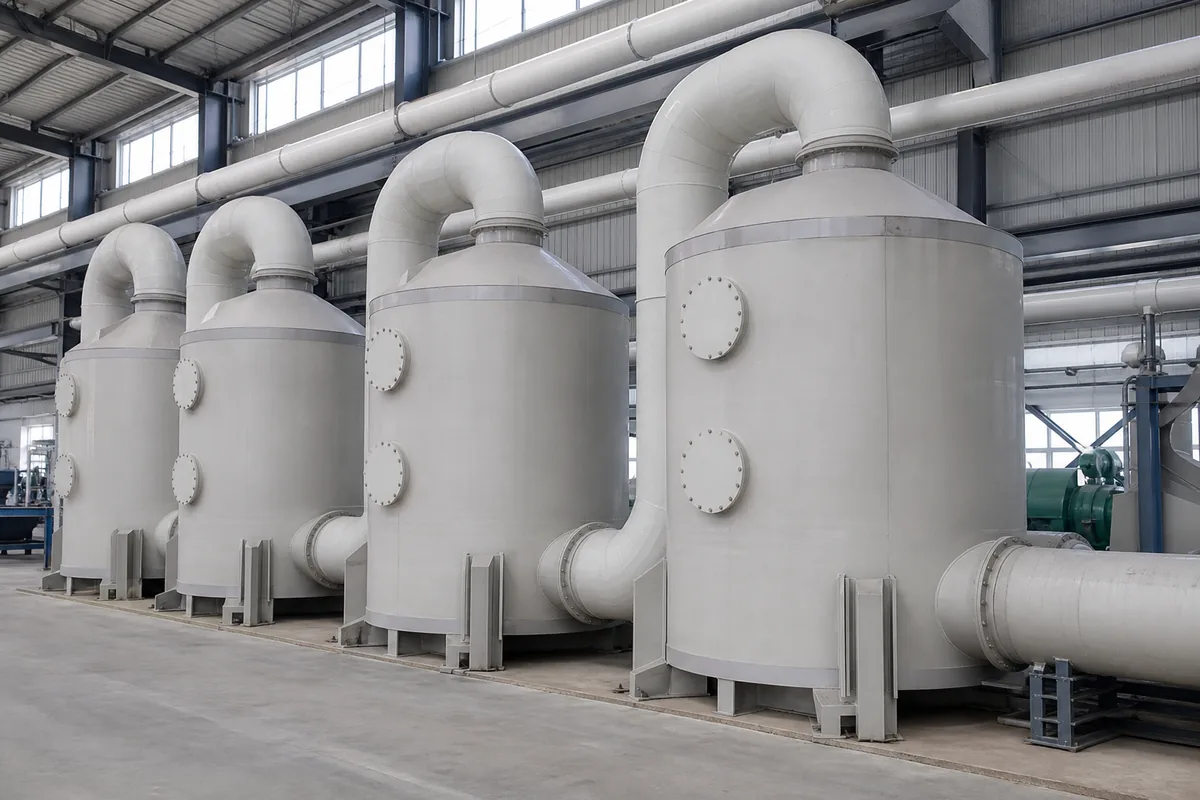
Material selection also matters. For corrosive odor gas, PP vessels and PP ducting are commonly used because they resist many acids, alkalis, and wet H₂S environments. However, PP temperature limits must be respected. For many PP systems, continuous gas temperature is usually kept below about 70–80°C, depending on PP grade, structure, and mechanical design.
When to Use Single Bed, Layered Bed or Two-Stage Treatment
A single carbon bed works when the odor chemistry is simple and stable. For example, a pump station with mainly H₂S can use alkaline or catalytic impregnated carbon.
A layered bed is useful when the inlet contains more than one odor type. The order of layers should be selected carefully. Acid-impregnated media for NH₃ and alkaline-impregnated media for H₂S should not be mixed without engineering review, because they can neutralize each other if dust or moisture migrates.
A two-stage system is often better when gas composition changes strongly. Examples:
- Wet scrubber + carbon
- Scrubber removes high H₂S or NH₃ load.
- Carbon polishes remaining odor.
- Good for high humidity and variable peaks.
- H₂S carbon + ammonia carbon
- First stage targets acidic sulfur gas.
- Second stage targets alkaline gas.
- Useful where both H₂S and NH₃ are present.
- VOC carbon + impregnated odor carbon
- First stage captures heavier VOCs.
- Second stage removes sulfur or nitrogen odor.
- Used when solvents and odor compounds are mixed.
Breakthrough monitoring should match the target gas. H₂S is easy to measure with portable meters or fixed sensors. NH₃ can also be monitored. Mercaptans may require more sensitive instruments or lab methods. Odor complaints may occur before common gas sensors show high readings, so field odor observation and process history are useful.
A practical replacement rule is to track:
`text Media life = total carbon capacity used / actual inlet mass load `
Mass load can be estimated as:
`text Gas load (g/h) = Concentration (mg/m³) × Airflow (m³/h) / 1000 `
For ppm conversion at 25°C and 1 atm:
`text mg/m³ = ppm × molecular weight / 24.45 `
Example for H₂S:
`text 20 ppm H₂S × 34.08 / 24.45 = 27.9 mg/m³ At 5,000 m³/h: 27.9 × 5,000 / 1000 = 139.5 g/h H₂S `
Then compare this with the working capacity of the selected carbon under similar conditions. Do not use only theoretical capacity; real working capacity is lower due to humidity, channeling, safety margin, and breakthrough limit.
Practical Next Step
Before selecting impregnated carbon, prepare a simple odor data sheet: airflow, temperature, humidity, target gases, average and peak concentration, operating hours, and required outlet limit. If the gas is mixed or unknown, take samples during worst-case operation. With this data, an equipment supplier can compare single-bed carbon, layered media, or wet scrubber plus carbon and size the PP adsorber, fan, ducting, and pressure drop correctly.