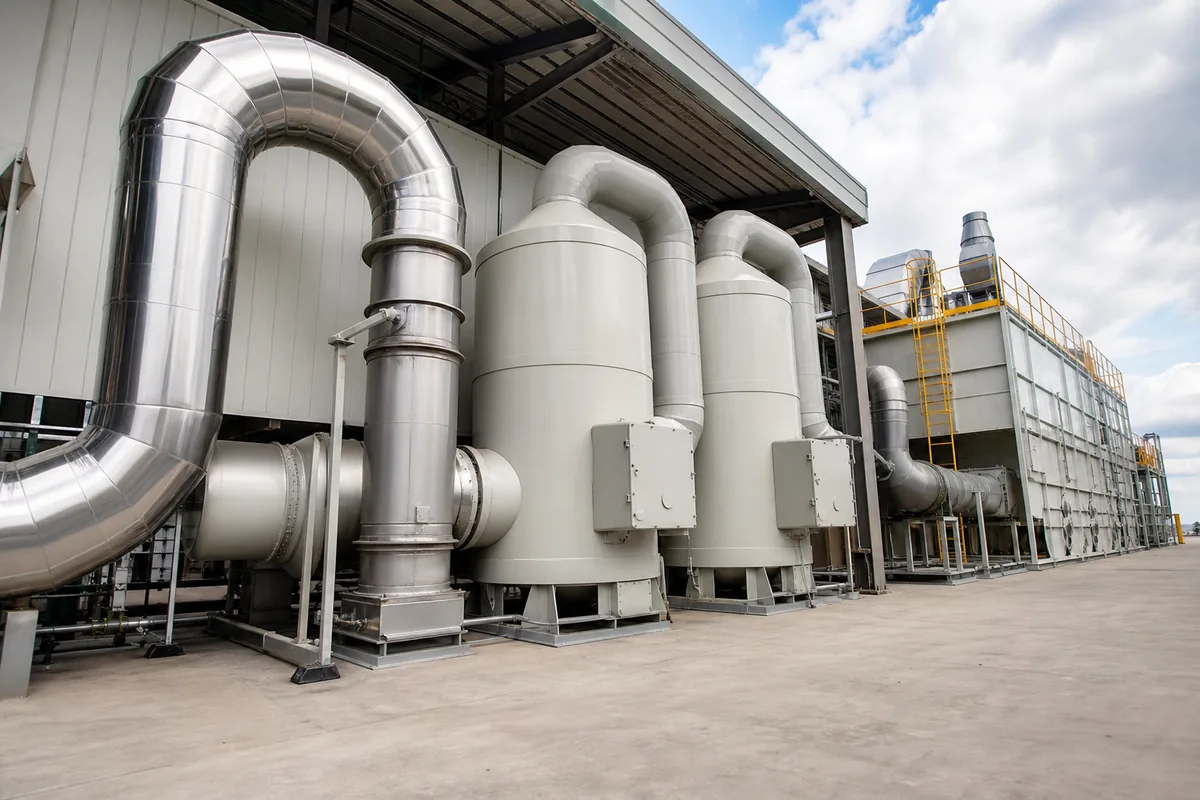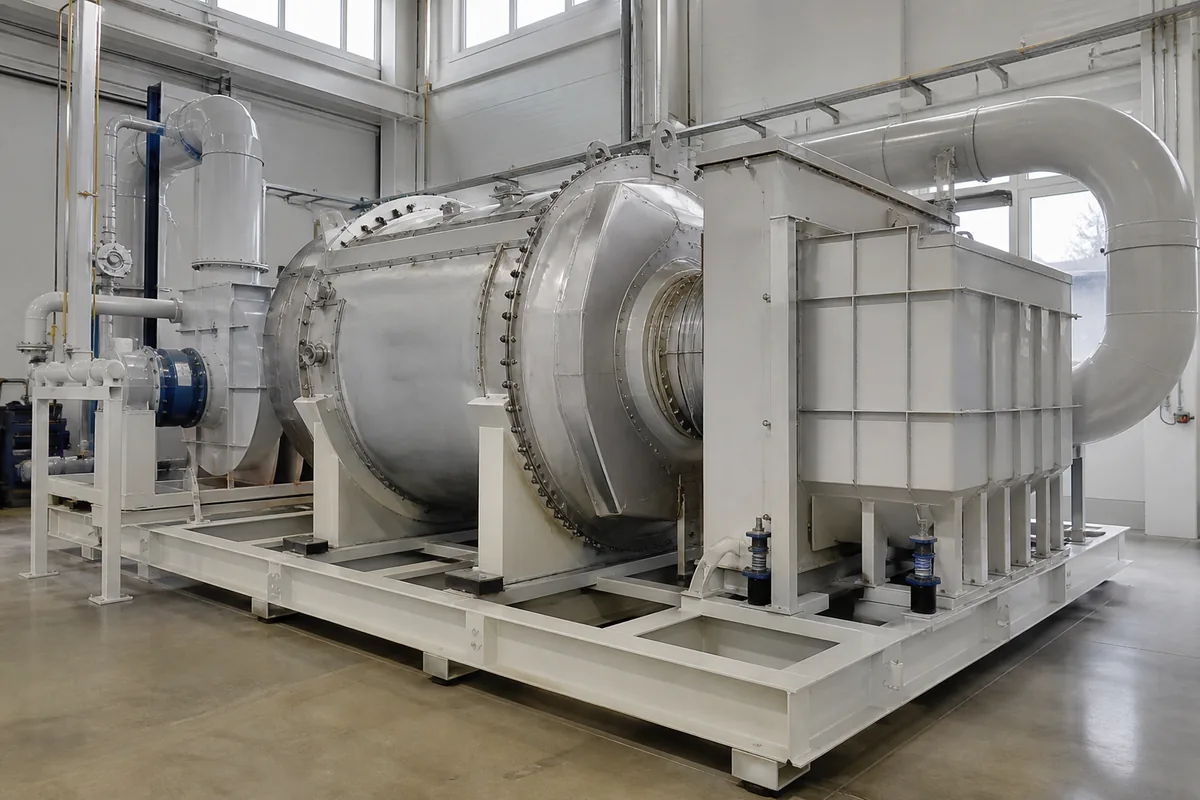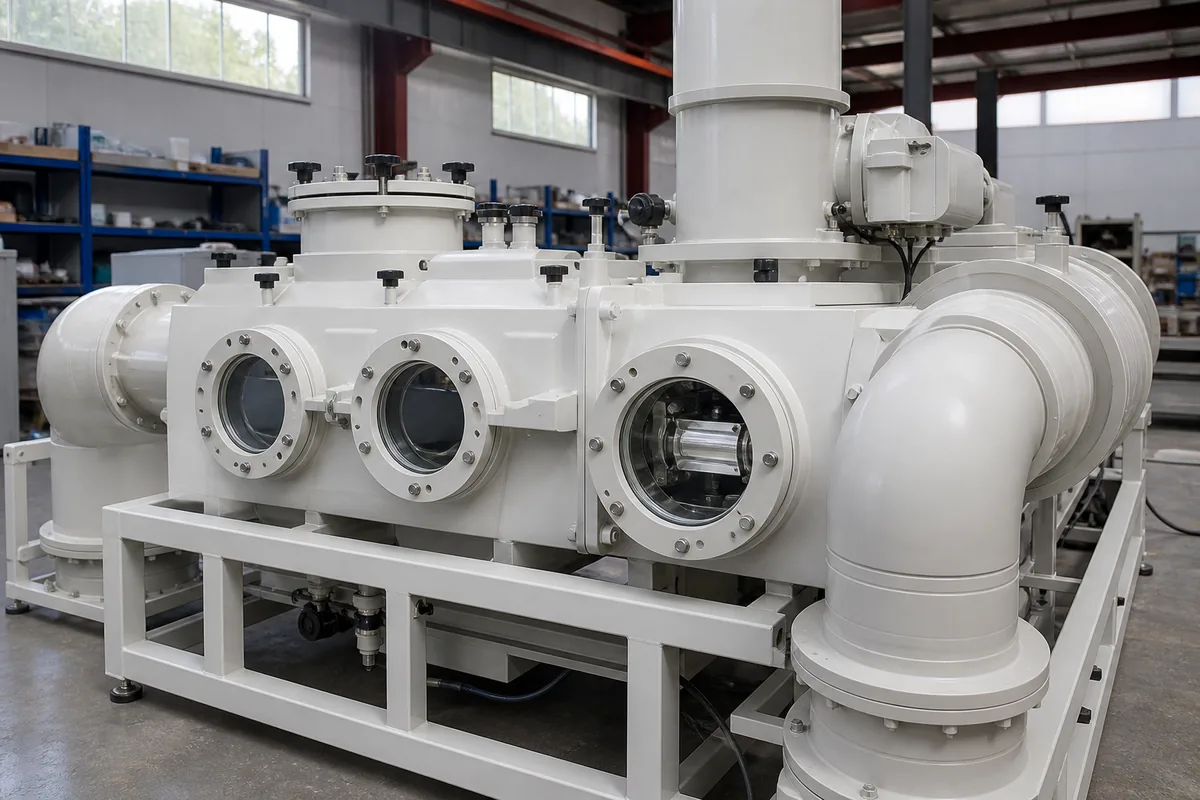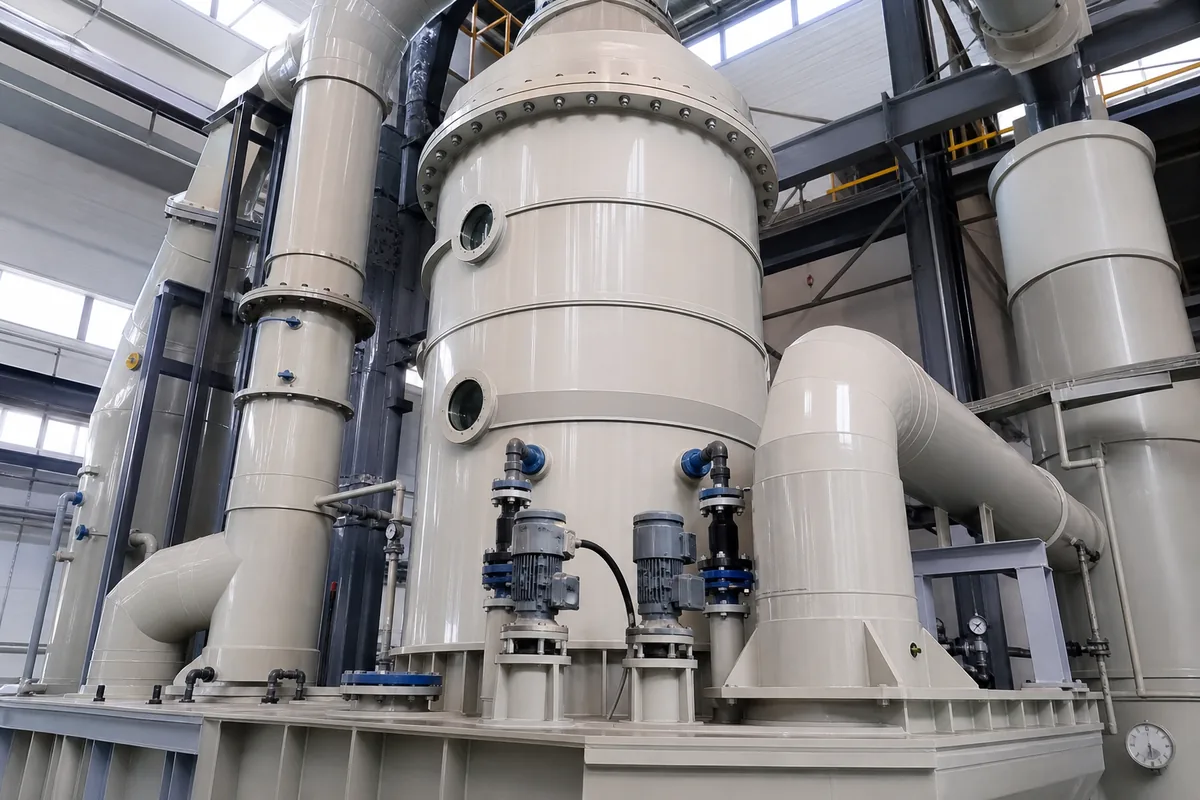
Why HF Exhaust Is a Special Corrosion Problem
Hydrofluoric acid (HF) exhaust is different from many other acid gas streams. A normal PP wet scrubber that works well for HCl, H₂SO₄ mist, or alkaline fumes may not be reliable for HF service unless the full gas composition, temperature, concentration, and droplet loading are checked carefully.
The main reason is that HF attacks many materials in ways that are not obvious from general acid resistance charts. It can react with glass, silica fillers, some coatings, some FRP systems, and many metals. Even low HF concentrations can create long-term damage if condensate forms inside ducts, fans, dampers, or scrubber internals.
For engineers selecting hf acid scrubber material, the question is not only “Can PP resist HF?” A better question is:
Where will HF be present, in what concentration, at what temperature, and will liquid condensation or fluoride salts form?
PP is often useful in HF exhaust systems, but it is not automatically suitable for every part of the system.
Where PP Works and Where It Becomes Risky
Polypropylene (PP) has good resistance to many dilute acids and is commonly used for wet scrubber bodies, tanks, ducting, demisters, and packing supports. For many dilute HF fume applications at moderate temperature, PP can be a practical material. However, there are several limits.
Typical PP engineering limits used in scrubber design:
- Continuous service temperature: commonly up to 70–80°C, depending on load and wall thickness
- Short-term temperature exposure: sometimes up to 90–100°C, but deformation risk increases
- Thermal expansion: about 0.10–0.15 mm/m·°C, much higher than steel
- UV resistance: outdoor PP normally needs UV-stabilized material or protection
- Mechanical stiffness: lower than steel and FRP; large equipment needs enough ribs and supports
In HF exhaust, PP can become risky in the following cases:
- High temperature gas
- If gas enters above 80°C, PP ducting and scrubber inlet areas may soften or deform.
- Hot spots near process tools, ovens, or reactors are especially dangerous.
- High HF concentration with condensation
- Dry HF gas may behave differently from wet HF condensate.
- If the gas cools below dew point, concentrated acid droplets can form on duct walls.
- Abrasive fluoride particles
- Processes such as etching, mineral treatment, or battery material production may generate fluoride salts.
- Particles can erode PP elbows, fan impellers, and spray zones.
- Solvent or oxidizer mixed with HF
- PP resistance can drop if HF exhaust also contains strong oxidizers, chlorinated solvents, ketones, or high-VOC content.
- Material selection must consider the complete gas mixture, not HF alone.
A useful rule of thumb: if the HF exhaust is dilute, wet, below 60°C, and without strong oxidizers or abrasive dust, PP is often considered first. If the exhaust is hot, concentrated, dry-to-wet cycling, or mixed with aggressive chemicals, review alternative materials or lined construction.
Comparing Materials for HF Scrubber Systems
No single material is best for every HF exhaust system. The material must be selected by equipment section: ducting, fan, scrubber shell, packing, mist eliminator, piping, pumps, and fasteners.
The table below gives a practical comparison. It is not a substitute for chemical compatibility testing because actual performance depends on concentration, temperature, velocity, stress, and impurities.
| Material | Typical Use in HF Exhaust | Advantages | Main Risks / Limits |
|---|---|---|---|
| PP | Scrubber shell, ducting, tanks, packing supports, demister frames | Good for many dilute acid fumes; weldable; light weight; common in wet scrubbers | Temperature limit; low stiffness; possible stress cracking with mixed chemicals; not suitable for all hot or concentrated HF cases |
| PVDF | High-corrosion parts, spray piping, nozzles, liners, special ducts | Better chemical and temperature resistance than PP in many acid services | Higher material cost; welding and fabrication require more control; still must check full gas composition |
| PTFE / PFA | Gaskets, liners, flexible connections, special internals | Very high chemical resistance; useful for severe HF and mixed acid areas | Mechanically soft; difficult as full structural material; usually used as liner or component |
| PE / HDPE | Tanks, some ducts, low-temperature wet areas | Good chemical resistance in some dilute acid service; easy fabrication | Lower temperature capability than PP in many designs; mechanical stiffness limits |
| FRP with suitable resin | Large ducts or vessels where stiffness is needed | Good strength-to-weight ratio; large sizes possible | HF can attack glass fiber if resin barrier is damaged; resin selection and liner quality are critical |
| Rubber-lined steel | Fans, ducts, tanks, high mechanical load areas | Strong structure; replaceable lining possible | Lining defects cause rapid corrosion; not ideal for all temperatures or oxidizing mixtures |
| Special alloys | Some process connections or high-temperature parts | High strength, temperature resistance | Many metals are not suitable for HF; alloy selection needs specialist review |
For many HF scrubbers, a mixed-material design is practical. For example, the scrubber body may be PP, but the spray nozzles may be PVDF, gaskets may be PTFE, and the fan may use PP, FRP with correct liner, or lined steel depending on gas temperature and pressure.
Design Conditions That Decide the Material
Before choosing an HF scrubber material, collect operating data. In our factory design reviews, missing data is the most common reason for wrong material selection.
Important design inputs include:
- HF concentration at source: ppmv, mg/Nm³, or approximate process chemical use
- Gas flow rate: normal and maximum, m³/h
- Gas temperature: normal, maximum, and possible upset temperature
- Humidity and dew point: whether condensation will occur in ducting
- Other gases: HCl, HNO₃, H₂SO₄ mist, NH₃, Cl₂, solvents, oxidizers
- Particle content: fluoride salts, SiO₂ dust, metal powder, sludge aerosols
- Operating schedule: continuous, batch, startup/shutdown cycles
- Required removal efficiency: based on local permit or plant target
- Available water and wastewater treatment: HF scrubbing produces fluoride wastewater
A basic wet scrubber for HF commonly uses alkaline solution, often NaOH, KOH, or calcium-based chemistry depending on wastewater strategy. The main neutralization reaction with caustic soda is:
`text HF + NaOH → NaF + H₂O `
Stoichiometrically, 1 kg of HF requires about 2.0 kg of NaOH for neutralization. In real operation, dosing is higher because of pH control, side reactions, and mass transfer limits. A practical operating pH for HF alkaline scrubbing is often 8.5–10.5, but this depends on the process and wastewater requirements. Very high pH can increase scaling with some fluoride salts.
For packed tower design, typical first estimates are:
- Gas velocity in packed section: 1.0–2.0 m/s for many acid gas scrubbers
- Liquid-to-gas ratio: 1.5–4.0 L/m³, depending on HF load and packing type
- Packing height: often 1.0–2.5 m for simple acid gas absorption; higher if efficiency target is strict
- Pressure drop: commonly 800–2000 Pa for scrubber body, excluding duct and fan losses
- Mist eliminator face velocity: often 2.0–3.5 m/s, depending on demister style
These are starting points only. High removal efficiency, variable flow, or sticky fluoride salts may require different values.
Failure Signs That PP Is Not Enough
Material problems in HF systems often appear slowly. Maintenance teams should not wait until a duct collapses or a fan fails. Look for early signs during inspections.
Common warning signs include:
- Softening or deformation near scrubber inlet, fan inlet, or hot duct sections
- White crystalline deposits on joints, flanges, demisters, and elbows
- Cracks at weld seams or corners of PP ducting and tanks
- Frequent demister blockage from fluoride salt carryover
- Fan vibration increase due to impeller corrosion, deposits, or imbalance
- Leaks around gaskets and bolts, especially where PTFE or EPDM was not selected correctly
- Chemical smell after scrubber, showing poor absorption or mist carryover
- Unexpected pH or fluoride increase in wastewater stream
If these symptoms appear, do not only increase caustic dosing. Chemical dosing may improve removal, but it will not solve material softening, thermal deformation, or abrasion. The root cause may be gas temperature, condensation point, wrong material, poor drainage, or insufficient mist elimination.
A simple site check is to measure temperatures at several points:
`text Process outlet → duct before fan → fan outlet → scrubber inlet → scrubber outlet `
If any PP section is regularly above 70–80°C, review the design. Also check whether hot gas cools in a long duct before the scrubber. This can create concentrated HF condensate inside ducting, where velocity and drainage are poor.
Practical Next Step
Before replacing an existing scrubber or buying a new one, prepare a one-page data sheet with gas flow, HF concentration, temperature range, humidity, other chemicals, particles, and target outlet level. Mark which sections are PP, PVDF, FRP, lined steel, or other materials.
Send this information to the equipment supplier and ask for a material-by-material review of the full system: ducts, fan, scrubber shell, packing, spray system, demister, tank, pump, gaskets, and drains. For HF exhaust, correct material selection is usually more important than simply increasing scrubber size.