What Happens Inside a PP Wet Scrubber
A PP wet scrubber removes acid fume by bringing contaminated gas into contact with a circulating alkaline liquid. The acid gas dissolves into the liquid film or droplets, then reacts with the alkali. Cleaned gas leaves from the top or side outlet, while the scrubber liquor is collected in the tank and recirculated.
For many factory exhaust systems, the main acid fumes are:
- Hydrogen chloride (HCl) from pickling, etching, electroplating, and chemical storage
- Sulfur dioxide (SO₂) or sulfuric acid mist from chemical processes
- Nitric acid mist and NOx from metal treatment and laboratory exhaust
- Hydrofluoric acid (HF) from glass, semiconductor, and surface treatment processes
- Mixed acid fumes from chemical dosing rooms and wastewater treatment
The pp wet scrubber working principle has three basic steps:
- Mass transfer: acid gas moves from the air stream into water droplets or liquid film.
- Chemical neutralization: dissolved acid reacts with alkali such as NaOH.
- Mist removal: droplets are separated before clean gas goes to the stack.
Polypropylene (PP) is widely used because it has good resistance to many acids, alkalis, and salts at normal scrubber temperatures. In many cases, PP scrubbers are used below 70–80°C gas temperature. The exact temperature limit depends on wall thickness, reinforcement, chemical concentration, and continuous or intermittent operation.
Main Parts and Flow Path
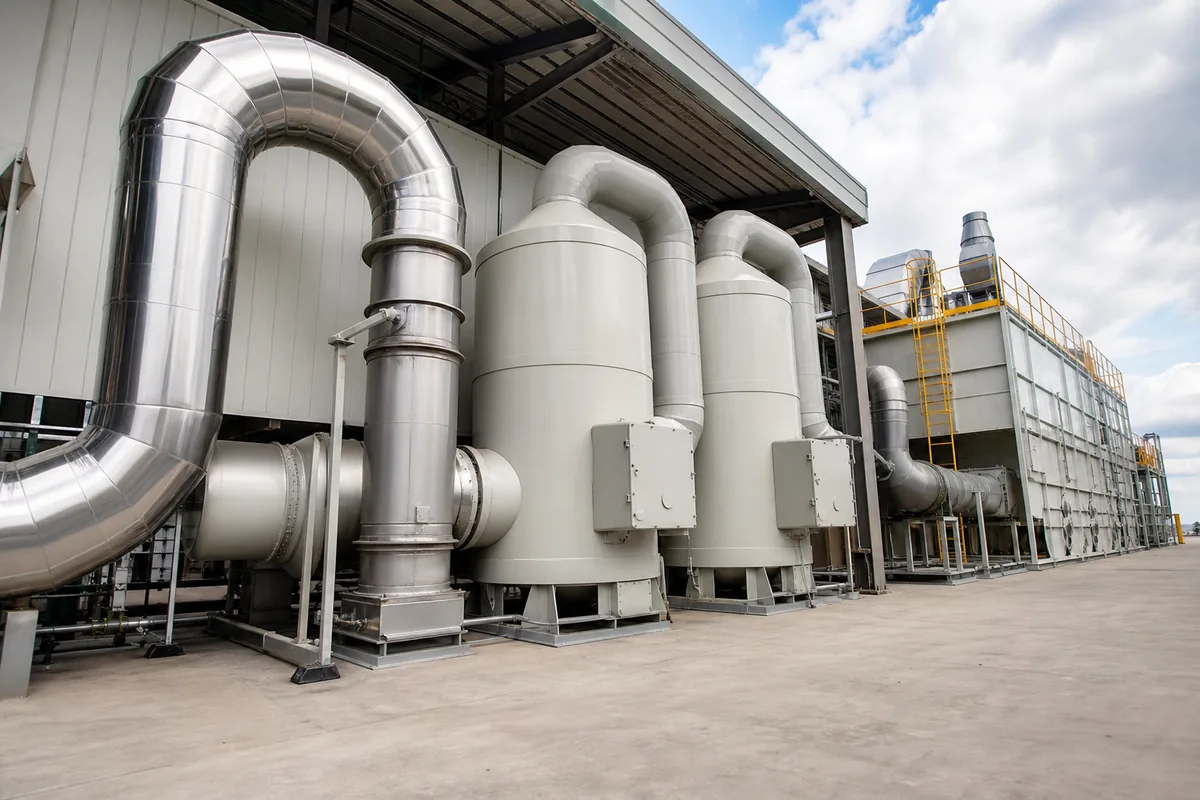
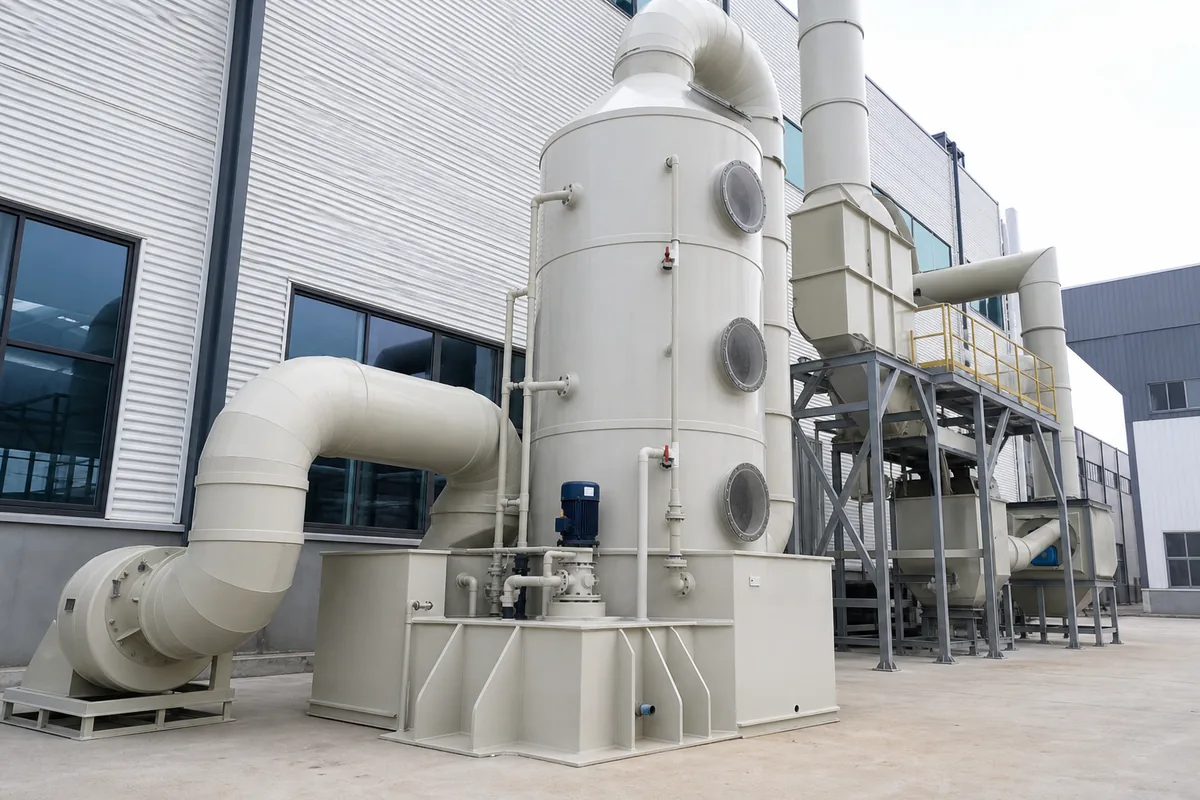
A typical vertical PP packed tower scrubber includes a sump tank, recirculation pump, spray headers, packing layer, mist eliminator, inspection ports, and fan connection. Horizontal scrubbers are also used where building height is limited, but vertical towers are common because they provide stable gas-liquid contact.
The usual flow path is:
- Acid fume enters the scrubber inlet.
- Gas velocity is reduced and distributed across the tower section.
- Recirculated liquid is sprayed over the packing.
- Gas passes through wetted packing, usually counter-current to the liquid.
- Acid components dissolve and react in the liquid phase.
- Droplets are removed by the demister.
- Treated gas exits to the fan and stack, or the fan may be installed before the scrubber depending on layout.
Common design ranges are shown below. These are rules of thumb, not fixed values for every project.
| Item | Typical range | Engineering note |
|---|---|---|
| Gas velocity in packed tower | 1.0–2.0 m/s | Lower velocity reduces pressure drop and mist carryover |
| Empty bed contact time | 1–3 seconds | Higher contact time helps difficult gases or high efficiency targets |
| Packing height | 0.8–2.0 m | Depends on solubility, inlet concentration, and removal target |
| Liquid-to-gas ratio | 1–3 L/m³ gas | Higher for high concentration, heat load, or poor solubility |
| Pressure drop | 800–1800 Pa | Includes packing, sprays, demister; depends on design |
| Scrubbing liquid pH | 8–10 for many acid gases | Some applications require tighter control |
| Demister face velocity | 2–3.5 m/s | Too high causes droplet carryover |
For example, if the exhaust flow is 10,000 m³/h and the selected liquid-to-gas ratio is 2 L/m³, the circulation rate is:
`text 10,000 m³/h × 2 L/m³ = 20,000 L/h = 20 m³/h `
This is only the recirculation flow. The actual fresh water makeup is much lower and depends on evaporation, bleed-off, and salt concentration in the sump.
Acid Absorption and Neutralization
The core of the pp wet scrubber working principle is absorption plus neutralization. Water alone can absorb some acid gases, but its capacity is limited. If alkali is added, the dissolved acid is consumed by reaction, which allows more acid to transfer from the gas phase into the liquid.
Typical reactions include:
`text HCl + NaOH → NaCl + H₂O
H₂SO₄ + 2NaOH → Na₂SO₄ + 2H₂O
HF + NaOH → NaF + H₂O `
For HCl, the theoretical NaOH requirement can be estimated from molecular weights:
- HCl molecular weight: 36.5
- NaOH molecular weight: 40.0
- Molar ratio: 1 mol HCl : 1 mol NaOH
So, 1 kg of pure HCl requires about 1.10 kg of pure NaOH for neutralization.
In real operation, chemical use is higher because of control margin, incomplete mixing, blowdown loss, and side reactions. A practical factor may be 1.1–1.5 times theoretical, depending on control method and stability of the process.
For a simple estimate:
`text NaOH required (kg/h) = acid load (kg/h) × stoichiometric factor × operating excess factor `
If an exhaust contains 2 kg/h of HCl, then:
`text Theoretical NaOH = 2 × 40 / 36.5 = 2.19 kg/h With 30% excess = 2.19 × 1.3 = 2.85 kg/h pure NaOH `
If using 30% NaOH solution, solution consumption is:
`text 2.85 / 0.30 = 9.5 kg/h of 30% NaOH solution `
This calculation is useful for chemical tank sizing and operating cost estimation, but the actual dosing rate should be adjusted by online pH measurement and site operation data.
Important process variables include:
- pH: For many acid scrubbers, pH 8–10 is a practical range. Very high pH may increase chemical consumption and scaling risk.
- Conductivity or TDS: Salt concentration rises as acid is neutralized. Blowdown is needed to control buildup.
- Liquid temperature: Absorption and material strength are affected by temperature.
- Oxidation state: Some gases, such as NOx, are not removed well by simple alkaline scrubbing unless oxidized or treated by a special process.
Packing, Sprays, and Mist Elimination
The packing section creates a large wetted surface area. Gas flows through void spaces while liquid spreads over packing surfaces. More surface area improves mass transfer, but too much resistance increases fan power.
Common PP packing types include Pall rings, Tellerette-style packing, and structured packing. Random PP Pall rings are often selected because they are simple, corrosion-resistant, and easy to replace.
Spray nozzles must distribute liquid evenly over the tower cross-section. Poor spray coverage causes dry channels, reducing removal efficiency. For maintenance, nozzles should be accessible through inspection ports. In dirty service, larger-orifice nozzles are usually safer than very fine atomizing nozzles, because they block less easily.
The demister is installed after the contact zone. Its job is not chemical removal, but droplet separation. Without a good demister, alkaline droplets and dissolved salts can leave the scrubber, causing white plume, corrosion in downstream ducting, or deposits on the fan.
Typical demister design points:
- Use PP mesh pad or PP chevron type depending on gas cleanliness and fouling risk.
- Keep velocity within the supplier’s design range, commonly around 2–3.5 m/s.
- Provide wash spray if salt crystallization or solids are expected.
- Install access doors for cleaning. A demister that cannot be cleaned will eventually become a pressure drop problem.
Pressure drop is a useful health indicator. If the scrubber pressure drop slowly increases, possible causes are salt scaling, blocked packing, dirty demister, or too high liquid rate. If pressure drop suddenly drops, possible causes are pump failure, blocked spray header, broken packing support, or bypass leakage.
How to Operate and Control the Scrubber
A PP wet scrubber is simple equipment, but stable operation depends on correct control. The minimum recommended instruments are:
- Differential pressure gauge across the scrubber
- pH probe in the circulation tank
- Liquid level switch or transmitter
- Pump pressure gauge
- Flow indicator for recirculation line
- Make-up water and blowdown valves
- Fan running signal linked with pump operation
A common control sequence is:
- Start circulation pump.
- Confirm liquid flow and tank level.
- Start exhaust fan.
- Dose alkali based on pH setpoint.
- Open blowdown periodically or by conductivity control.
- Stop fan first, then stop pump after a short delay if required.
Do not run the fan through a dry scrubber if acid fume is present. Dry packing gives almost no absorption and may allow concentrated acid to attack downstream equipment.
For many acid gas systems, the pH setpoint can start at 8.5–9.5. After commissioning, adjust based on stack measurement, chemical consumption, and salt formation. If the pH swings quickly, check whether the alkali dosing pump is oversized, the pH probe is poorly located, or the sump mixing is weak.
Blowdown control is also important. Neutralization converts acid gas into salts. If these salts are not removed, they can crystallize on packing, nozzles, and demister. As a rough starting point, blowdown may be set at 1–5% of the circulation rate, but the correct rate depends on acid load, water quality, evaporation, and allowable wastewater concentration.
For safety and reliability:
- Use interlock: fan stops or alarms when scrubber pump fails.
- Provide overflow and drain lines to a suitable wastewater system.
- Avoid dead legs where sludge or crystals can collect.
- Keep spare nozzles, pH probe, pump seal parts, and demister sections if the process is continuous.
- Inspect PP welding, supports, and flange gaskets during shutdown.
Practical Next Step
Before selecting a scrubber size, prepare these basic data: exhaust flow rate in m³/h, gas temperature, acid type, inlet concentration or acid consumption rate, target outlet condition, available footprint, and wastewater limits. With these values, an engineer can estimate tower diameter, packing height, circulation rate, alkali consumption, fan pressure, and PP material thickness more accurately.