Why Carbon Beds Catch Fire
Activated carbon is an effective adsorbent for many VOCs, odors and solvent vapors, but it is not “passive” under all conditions. A carbon bed can heat up if the inlet gas contains sparks, hot particles, high solvent concentration, reactive chemicals, or oxygen-rich air with combustible vapor. Good activated carbon fire safety starts by understanding the heat sources and removing them before they reach the bed.
The main fire mechanisms are:
- External ignition: welding sparks, grinding dust, boiler ash, furnace particles, or hot process carryover enter the duct and ignite carbon dust or adsorbed solvent.
- Adsorption heat: when VOC molecules adsorb onto carbon, heat is released. This is normal, but high inlet concentration can raise the bed temperature quickly.
- Oxidation of carbon: at elevated temperature, activated carbon can slowly oxidize in air. If heat is not removed, temperature can continue to rise.
- Reactive contaminants: ketones, aldehydes, organic peroxides, strong oxidizers, and some sulfur compounds can react on carbon and generate heat.
- Poor operating practice: stopping the fan while the bed is loaded with solvent, closing dampers, or leaving a saturated bed in warm air can reduce cooling and allow heat accumulation.
As a rule of thumb, carbon adsorbers for VOC service should receive gas below 40–50°C in normal operation unless the carbon supplier and system designer approve a higher value. Relative humidity also matters: very wet gas reduces adsorption capacity, while very dry solvent-laden gas may increase static risk in some systems. For many industrial applications, 40–70% RH is a practical operating range, but this depends on the solvent and process.
The lower explosive limit (LEL) must also be considered. A common design rule is to keep VOC concentration below 25% of LEL during normal operation. For higher concentrations, other treatment methods such as condensation, thermal oxidation, nitrogen inerting, or dilution may be required before adsorption.
Spark Arrestors: What They Can and Cannot Do
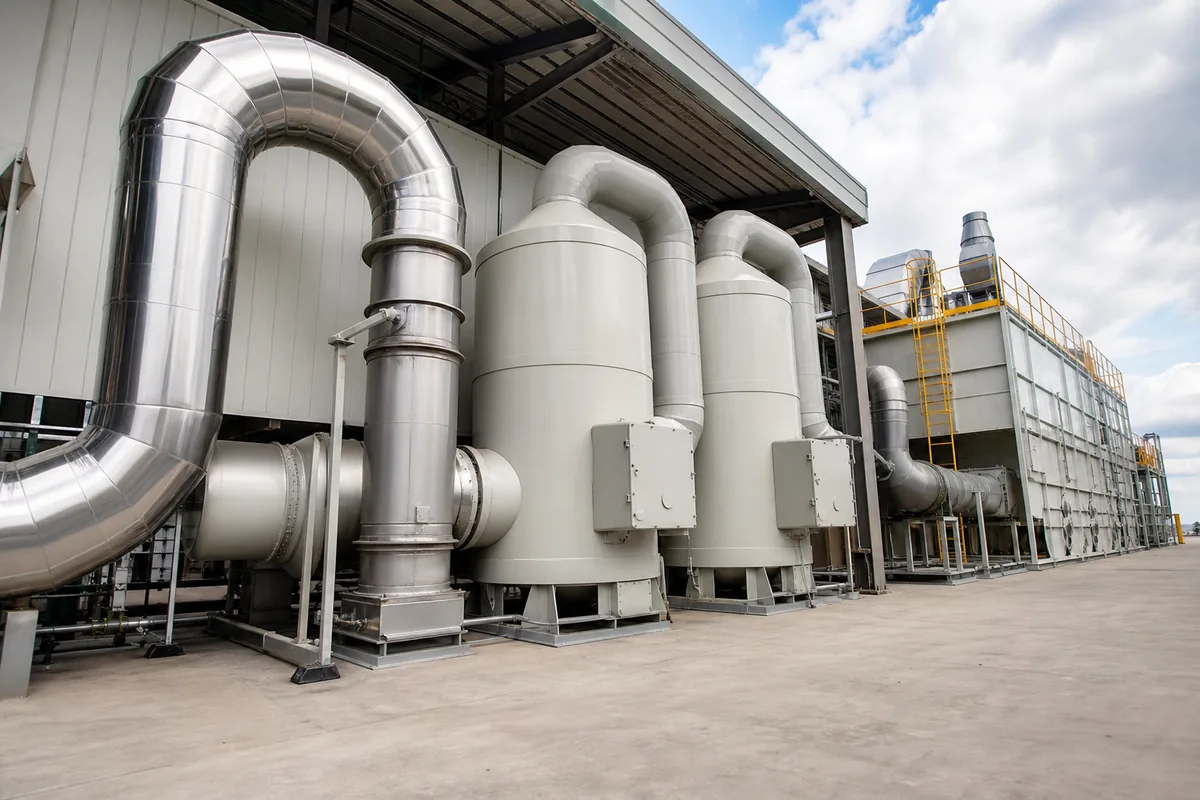
A spark arrestor is a device installed in the duct before the carbon adsorber to reduce the chance of burning particles entering the carbon bed. It is not a complete fire protection system. It cannot remove solvent vapor, stop a gas-phase flame in all cases, or make an unsafe process safe by itself.
Common spark control devices include baffle-type arrestors, mesh pads, centrifugal separators, and water spray quench sections. Selection depends on particle size, temperature, dust loading, airflow, and available pressure drop.
| Device type | Typical use | Advantages | Limitations |
|---|---|---|---|
| Baffle or labyrinth spark arrestor | Grinding, polishing, dry process exhaust | Simple, low maintenance, suitable for larger sparks | Less effective for fine hot particles; adds pressure drop |
| Stainless steel mesh pad | Light spark loading, small particles | Compact, easy to install | Can clog with dust or oil; needs frequent inspection |
| Cyclone or centrifugal separator | Dust and heavier particles | Removes some particulate before adsorber | Not enough for fine sparks alone; larger footprint |
| Water spray quench section | Hot gas, visible sparks, sticky particles | Cools gas and extinguishes many sparks | Adds moisture; needs drainage, mist eliminator, freeze protection if applicable |
| Flame arrester | Specific flammable gas systems | Designed for flame front control in defined conditions | Must be selected for gas group and installation; not a general dust spark trap |
For duct velocities, many PP and FRP scrubber/adsorber systems operate around 10–18 m/s in the main duct. A spark arrestor should be sized so that it does not create excessive pressure loss or dust buildup. For a clean baffle-type unit, pressure drop may be around 200–800 Pa, depending on design and velocity. Mesh or dirty units can be much higher.
Important design points:
- Install the spark arrestor upstream of the carbon adsorber, after major spark-generating equipment if possible.
- Provide access doors for inspection and cleaning.
- Use non-combustible internals in the hot particle zone when temperature or spark loading is significant.
- Avoid dead zones where dust can accumulate and later burn.
- If water spray is used, install a mist eliminator before the carbon bed. Liquid water carryover can damage carbon performance and increase pressure drop.
- If the process has both dust and VOCs, remove dust first. Carbon beds should normally see gas with low particulate loading, often below 5–10 mg/Nm³, depending on bed design and maintenance interval.
Bed Temperature Monitoring: Minimum Practical Arrangement
Temperature monitoring is one of the most useful tools for activated carbon fire safety. A carbon bed can heat internally before smoke or flame is visible at the outlet. One temperature sensor at the outlet duct is not enough for many systems because the hot zone may be inside the bed.
For a vertical downflow or upflow carbon adsorber, typical monitoring includes:
- Inlet gas temperature
- Outlet gas temperature
- At least one bed temperature probe
- Multiple bed probes for large units or deep beds
For small adsorbers, one probe at mid-depth may be acceptable, but for industrial beds, use several probes across the bed area. A practical layout is one probe per 1–2 m² of bed cross-section, with additional probes near the inlet side where adsorption heat is highest. For beds deeper than 800–1000 mm, consider probes at two depths.
Common alarm values depend on carbon type, solvent, and process risk. The following are typical starting points, not universal limits:
- Pre-alarm: bed temperature reaches 60–70°C
- High alarm: bed temperature reaches 80–90°C
- Emergency action: bed temperature reaches 100–120°C, or temperature rises faster than 2–3°C per minute
The rate of temperature rise is important. A bed slowly warming from 35°C to 55°C may be caused by warm process air. A rise from 45°C to 80°C in 10 minutes suggests active heat generation and requires immediate action.
Use temperature transmitters connected to the plant control system or local control panel. The system should show actual values, not only alarm lights. Trend data helps operators see if the bed is stable, heating, or cooling.
Operating Controls That Reduce Fire Risk
Fire safety is not only hardware. Many carbon bed incidents happen during abnormal operation: startup, shutdown, solvent change, maintenance, or fan failure.
A practical control philosophy should include:
- High inlet temperature interlock: stop process exhaust to the adsorber or open bypass if inlet temperature exceeds the setpoint.
- High bed temperature alarm: alert operators and start emergency procedure.
- Fan running proof: do not allow solvent exhaust to enter the adsorber unless the fan is running and airflow is confirmed.
- Low airflow alarm: insufficient flow reduces cooling and can allow VOC accumulation.
- Pressure drop monitoring: rising pressure drop indicates dust loading, wet carbon, or bed blockage.
- LEL monitoring when needed: if solvent concentration can approach unsafe levels, install an LEL sensor before the adsorber and set alarms conservatively.
- No hot work connection: welding, cutting, and grinding exhaust should not be routed to carbon beds unless sparks are removed and the risk is reviewed.
Pressure drop is a useful maintenance indicator. A clean fixed carbon bed may have a pressure drop of 800–1500 Pa, depending on bed depth, pellet size, velocity, and screens. If pressure drop increases by 30–50% from the clean baseline, inspect the bed and prefilters.
Superficial gas velocity through the carbon bed is commonly 0.2–0.6 m/s. Lower velocity improves contact time and reduces pressure drop, but increases equipment size. Empty bed contact time (EBCT) for VOC adsorption is often 0.5–2.0 seconds, depending on the solvent, target removal efficiency, carbon type, and inlet concentration.
Shutdown procedure matters. Do not stop the fan immediately after a high-solvent production run if the bed is warm. A common practice is to continue purging with clean air for 15–30 minutes, or longer for large beds, until bed temperature is stable. If the process uses high-boiling solvents, longer purge time may be needed.
Emergency Response and Maintenance Checks
Each site should have a written response plan. Operators must know what to do before an alarm occurs. Do not wait until smoke is visible.
A typical high bed temperature response may include:
- Stop VOC source or close inlet damper to the adsorber.
- Keep exhaust fan running if it is safe and helps cool the bed.
- Stop any heater or hot process feeding the duct.
- Open clean air purge if installed.
- Notify site safety personnel.
- If temperature continues to rise, follow the site fire plan and use the correct extinguishing method.
Water can cool a carbon bed, but it can also create contaminated wastewater, steam, carbon swelling, and structural load. Some systems include water deluge connections; others do not. If deluge is required, the adsorber shell, drain, supports, and downstream duct must be designed for it. For PP equipment, temperature limits must be considered because PP softens at elevated temperatures. Long exposure above 80–90°C can reduce mechanical strength.
Maintenance should focus on early detection:
- Inspect spark arrestors weekly at first, then adjust interval based on dust loading.
- Clean prefilters before pressure drop becomes excessive.
- Check temperature probes every 3–6 months for correct reading.
- Record carbon bed pressure drop, inlet temperature, outlet temperature, and bed temperature.
- Replace carbon before breakthrough becomes severe. A saturated bed has less safety margin.
- Avoid mixing unknown spent carbon with fresh carbon.
- Store spent carbon in closed metal containers or other site-approved containers, away from heat and rain.
When changing carbon, inspect internal screens, gaskets, hold-down grids, and distribution plates. Poor gas distribution can create local high velocity, early breakthrough, and uneven heat zones.
Practical Next Step
Before buying or modifying an activated carbon adsorber, prepare these data: airflow, VOC names and concentrations, temperature, humidity, dust loading, possible spark source, operating hours, and shutdown method. With these values, an equipment supplier can select the carbon bed size, spark arrestor type, temperature probe layout, pressure drop range, and alarm logic suitable for your process.