Why Chromic Acid Mist Is Difficult to Control
Hard chrome plating tanks release a fine mist when hydrogen and oxygen bubbles burst at the bath surface. The mist contains hexavalent chromium compounds from the chromic acid solution. It is corrosive, toxic, and can stain roofs, ducts, fans, and nearby equipment if the capture system is weak.
A typical hard chrome bath operates at:
- Chromic acid concentration: 180–350 g/L CrO₃
- Sulfuric acid ratio: commonly about 100:1 CrO₃:H₂SO₄ by weight, depending on process
- Temperature: 45–60 °C
- Current density: often 20–60 A/dm²
- Gas generation: increases with current, poor bath efficiency, and high agitation
The emission is not a hot gas plume like furnace exhaust. It is usually a low-temperature, moisture-saturated aerosol. Droplet size can be very small, especially when the tank uses high current density or air agitation. Because of this, the system needs both good hood capture and a mist removal device. A simple water spray tower may remove large droplets, but it may not be enough for fine chromic acid mist.
For most installations, the control train is:
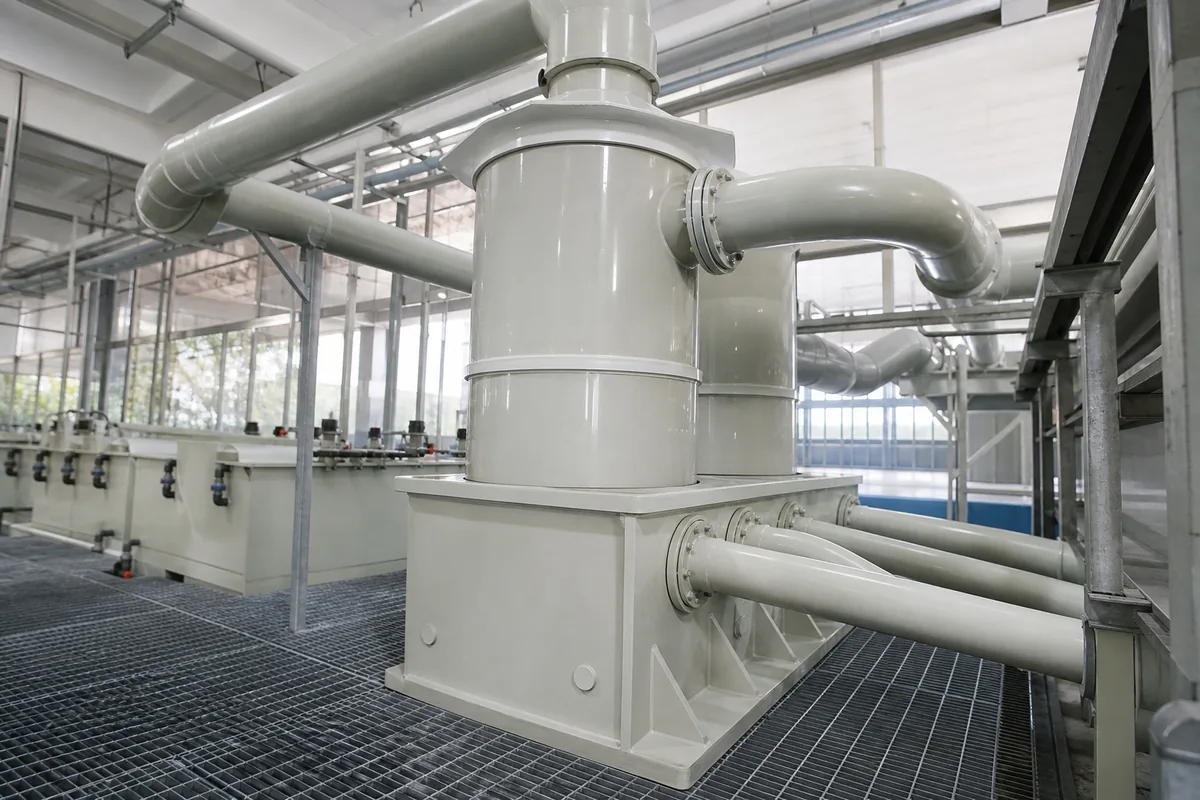
Tank hood or enclosure → PP duct → mist eliminator or packed scrubber → corrosion-resistant fan → stack
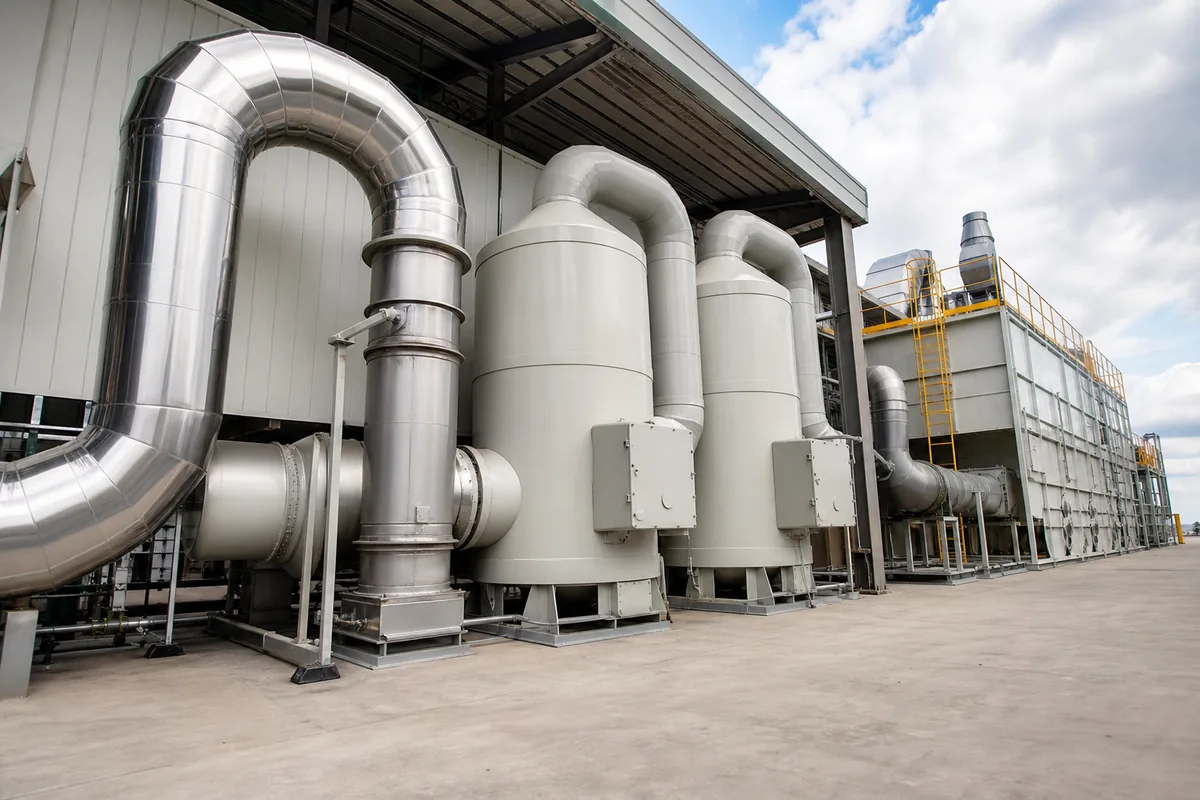
In many plants, the equipment is called a chrome plating fume scrubber, but the key point is that the system must be designed for acid mist, not only for soluble gas absorption.
Capture at the Plating Tank Comes First
If mist escapes the tank area, the downstream scrubber cannot recover it. Capture design is therefore the first engineering step.
Common capture methods are:
| Capture method | Typical use | Advantages | Main cautions |
|---|---|---|---|
| Lateral slot hood | Open hard chrome tanks | Good access for workpieces and cranes | Needs correct slot velocity and tank coverage |
| Push-pull hood | Wide tanks, high emission rate | Reduces exhaust volume compared with simple side suction | Must balance push air and exhaust carefully |
| Full or partial enclosure | Automatic lines, high control requirement | Best capture efficiency | Needs doors, maintenance access, and corrosion-resistant structure |
| Floating balls or surface suppressants | Emission reduction at source | Reduces mist load to exhaust system | Does not replace ventilation; chemistry must suit plating process |
For lateral slot hoods, a practical starting point is:
- Slot velocity: 8–12 m/s at the slot opening
- Face capture velocity over tank surface: commonly 0.3–0.7 m/s near the emission zone
- Duct velocity for wet acid mist: 10–15 m/s to prevent liquid settlement
- Hood material: PP, PVC, FRP, or coated steel depending on chemical and temperature conditions
Exhaust volume depends strongly on tank width, hood geometry, cross-drafts, and whether the tank is enclosed. As a rough estimate, open side-draft tanks may require 2,000–5,000 m³/h per square metre of tank surface. Wide tanks and poor room air control can require more.
Cross-drafts are a common cause of visible mist escape. Fans, open doors, air conditioning outlets, and forklift movement can disturb capture. As a rule of thumb, room air velocity across an open tank should be kept below 0.25–0.3 m/s where possible. If the workshop has strong drafts, an enclosure or push-pull design is often more reliable than simply increasing exhaust volume.
Scrubber and Mist Eliminator Selection
Chromic acid mist is mainly particulate aerosol. Water can dissolve chromium compounds, but only if the droplets contact the liquid or a wetted surface. The equipment choice should be based on droplet size, target removal efficiency, pressure drop, and maintenance capacity.
Common options include mesh pad mist eliminators, chevron demisters, packed towers, and multi-stage scrubbers. For hard chrome plating, a multi-stage PP wet scrubber is often used: inlet section, spray or packed section, and high-efficiency mist eliminator.
Typical design values are:
| Item | Common range | Notes |
|---|---|---|
| Scrubber gas velocity in tower | 1.5–2.5 m/s | Lower velocity improves mist removal but increases diameter |
| Packed bed depth | 600–1,500 mm | Depends on packing type and removal target |
| Liquid-to-gas ratio | 1–3 L/m³ gas | Higher values improve wetting but increase pump size and wastewater |
| Spray pressure | 0.15–0.3 MPa | Depends on nozzle type |
| Pressure drop, packed tower | 800–1,800 Pa | Add duct, hood, demister, and stack losses |
| Pressure drop, high-efficiency mist eliminator | 500–2,000 Pa | Depends on design and fouling condition |
A simple packed tower can remove acid gases well, but for fine chromic acid aerosol, the final demister is very important. A common arrangement is:
- Pre-wash spray zone to wet and cool the gas stream
- Packed bed to increase contact surface
- Wash spray above packing for continuous wetting
- Chevron or mesh mist eliminator to remove entrained droplets
- Clean water rinse spray for demister if chromium crystal buildup is expected
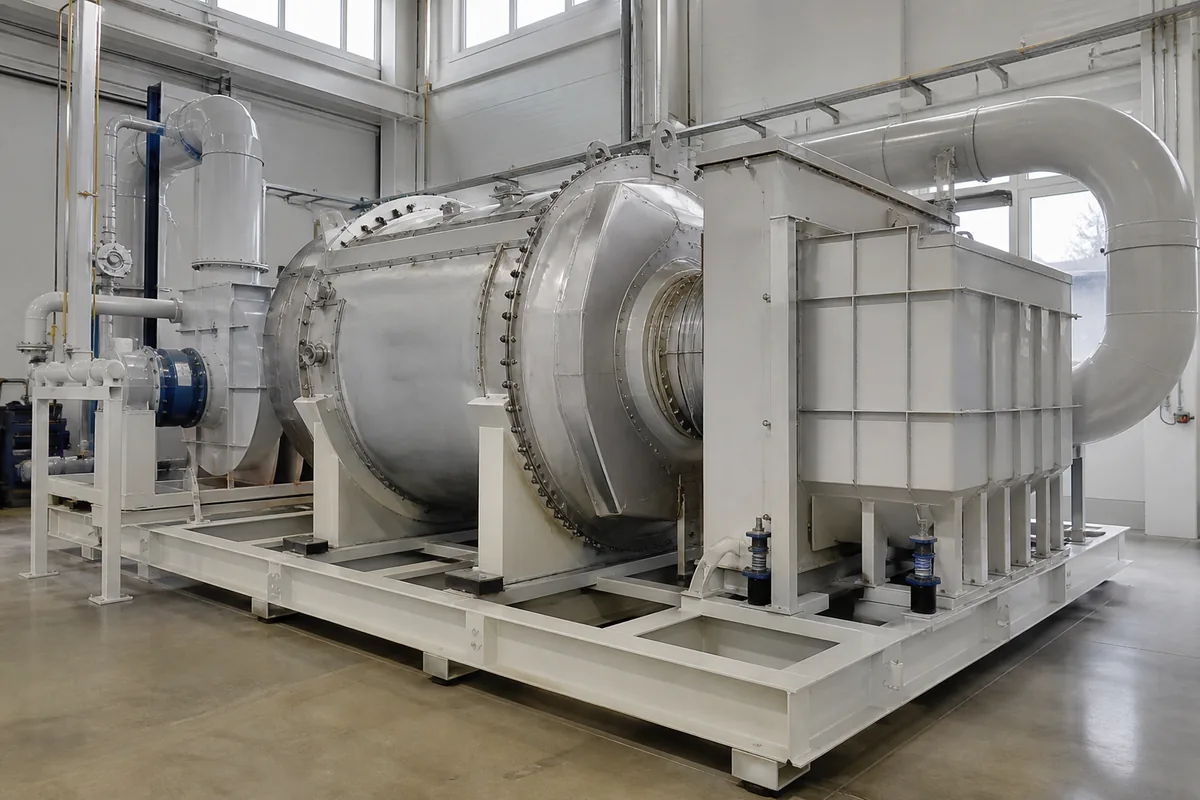
For very fine mist or strict outlet requirements, a higher-efficiency device may be needed, such as a fiber-bed mist eliminator or multi-stage wet electrostatic precipitator. These are more complex and must be selected based on actual emission limits and test data.
The scrubber should not be oversized only by increasing tower diameter. If gas velocity becomes too low, distribution can become poor and droplets may not be captured effectively. It is better to size the tower, spray system, packing, and demister together.
Materials, Fan Location, and Duct Details
Chromic acid mist attacks carbon steel quickly. For plating exhaust, common corrosion-resistant materials are PP, PVC, FRP, PVDF, or lined steel. PP is widely used for scrubber bodies, tanks, ducts, and hoods because it resists chromic acid at normal plating exhaust temperatures and is easy to fabricate by hot-air welding or extrusion welding.
Important material and layout rules:
- PP temperature limit: usually design below 80 °C for long-term service; check actual grade and load condition.
- Duct slope: slope horizontal wet ducts back to a drain point, typically 1–2%.
- Cleanout ports: install at bends, low points, and long horizontal duct sections.
- Drain seals: use water seals or traps to prevent air leakage.
- Expansion allowance: PP ducts expand more than steel. Use flexible connectors and proper supports.
- Support spacing: depends on duct diameter and wall thickness; large PP ducts need close support to prevent sagging.
- Avoid dead legs: chromium solution can crystallize in stagnant areas.
The fan can be installed before or after the scrubber. For chromic acid mist, placing the fan after the scrubber is usually preferred because the fan handles cleaner, cooler, less corrosive gas. However, this means the scrubber and duct before the fan operate under negative pressure, so air leakage can reduce capture performance if joints are poor.
Fan selection must include total static pressure:
`text Total pressure = hood loss + duct loss + scrubber loss + demister loss + stack loss + safety margin `
A typical chrome plating exhaust system may have total pressure of 2,000–4,500 Pa, but this depends on duct length, elbows, scrubber type, and demister design. Add a reasonable fouling margin, often 10–20%, especially where chromium crystals can build up.
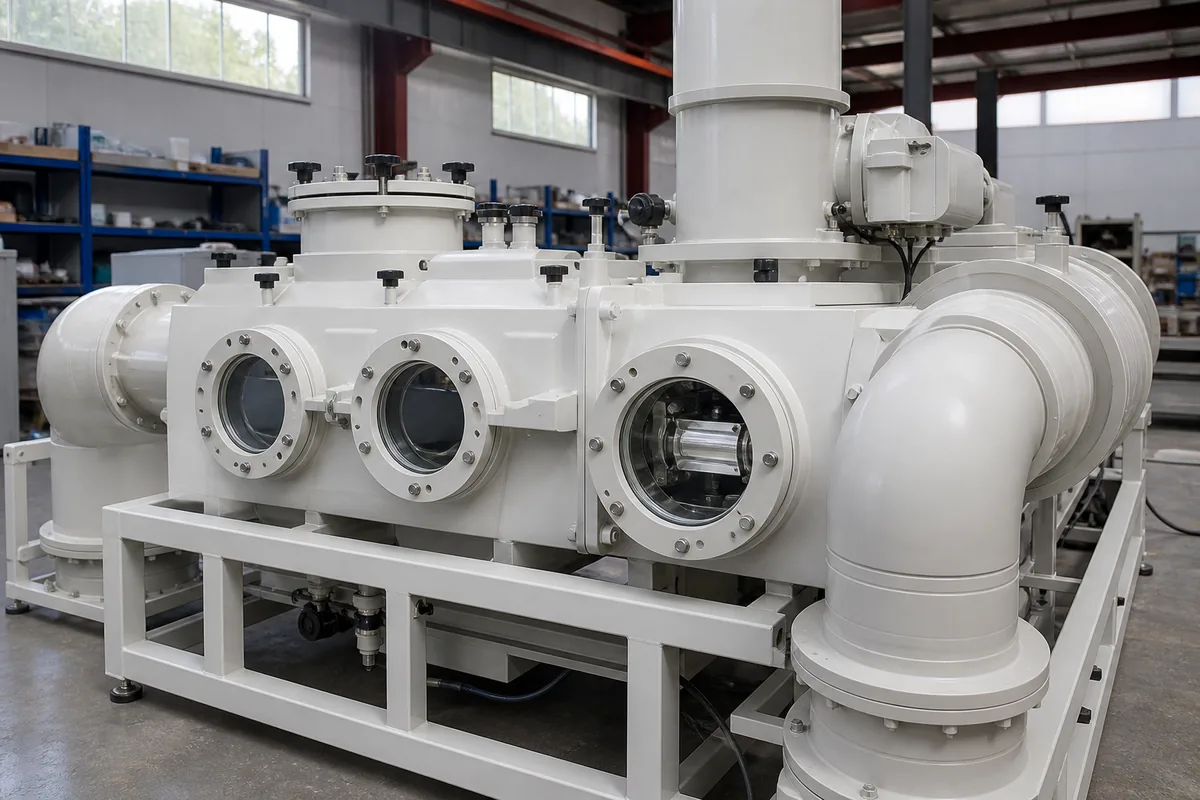
Use a corrosion-resistant fan material suitable for the gas. PP fans are common for moderate temperature acid mist. FRP fans may be used for larger sizes or higher pressure. The fan motor should be outside the gas stream where possible.
Water Chemistry, Wastewater, and Maintenance
A chrome plating fume scrubber transfers chromium from the air into the recirculating liquid. This liquid must be managed. It is not just “water”.
The recirculation tank will gradually accumulate:
- Hexavalent chromium
- Acid from the plating bath
- Dissolved metals from dragged mist
- Suspended solids and crystals
- Possible surfactant or suppressant residues
The scrubber water pH is often acidic. Neutralizing inside the scrubber is not always the best choice because it can form solids and block packing or nozzles. Many plants keep the scrubber loop acidic and bleed a controlled flow to a wastewater treatment system designed for chromium reduction and precipitation.
A simple mass balance helps estimate bleed rate:
`text Chromium in mist captured per day = chromium leaving in bleed per day `
If chromium input is high and bleed is too low, concentration rises and crystallization becomes more likely. Actual emission load depends on tank current, bath chemistry, suppressants, and capture efficiency, so site measurement is better than guessing.
Maintenance points that should be written into the operating plan:
- Check pump flow and spray pressure daily or weekly.
- Inspect nozzles for blockage; acid mist systems often form deposits.
- Wash mist eliminator regularly before pressure drop becomes high.
- Record pressure drop across packing and demister.
- Inspect PP welds, flanges, access doors, and drain lines.
- Confirm fan vibration and belt condition if belt-driven.
- Clean transparent level gauges; chromium staining can hide true level.
- Do not allow scrubber pump to run dry.
A rising pressure drop usually means packing or demister fouling. A falling pressure drop may mean low liquid level, pump failure, broken packing support, or open access door. Both conditions require attention.
Practical Next Step
Before selecting a chrome plating fume scrubber, prepare the basic process data: tank length, width, bath temperature, current load, hood type, available layout, duct route, required outlet limit if known, and wastewater treatment method. With these values, an engineer can calculate exhaust volume, scrubber diameter, pressure drop, fan duty, and material thickness instead of guessing from tank size alone.