Why carbon change-out needs a planned procedure
Activated carbon adsorbers look simple, but changing the carbon is one of the higher-risk maintenance tasks in a VOC or odor control system. The spent carbon may contain flammable solvents, toxic vapors, acids, alkalis, moisture, or heat from adsorption reactions. A poor activated carbon change out procedure can expose workers to VOCs, create dust explosion risks, damage the vessel internals, or cause unexpected production downtime.
For most industrial VOC systems, carbon is changed for one of four reasons:
- Breakthrough concentration reaches the site limit or permit limit.
- Outlet odor becomes unacceptable.
- Pressure drop becomes too high, often due to dust, oil mist, or wet carbon.
- A fixed preventive maintenance interval has been reached.
Typical design values for fixed-bed activated carbon adsorbers are:
- Superficial gas velocity: 0.15–0.6 m/s, depending on bed depth and VOC type.
- Bed depth: 600–1,200 mm for many industrial VOC applications.
- Pressure drop across clean carbon bed: often 800–1,800 Pa, depending on bed depth, pellet size, and airflow.
- Practical working carbon capacity: often 5–25% by weight for mixed VOC streams, but it can be much lower for very light compounds or humid gas.
Do not assume carbon is safe because the fan has stopped. Adsorbed VOCs can desorb when temperature rises or when fresh air passes through the bed. Some spent carbon can self-heat, especially if it has adsorbed ketones, aldehydes, sulfur compounds, or reactive organics.
Pre-job checks and isolation
Before opening the adsorber, prepare a written work plan. The plan should name the job leader, isolation points, gas testing method, disposal route, and restart criteria. For a simple single-vessel adsorber, a small team may complete the work in one shift. For large beds, dual vessels, or confined-space entry, allow more time.
Minimum pre-job checks should include:
- Review the latest inlet and outlet VOC data, pressure drop trend, and operating temperature.
- Identify the adsorbed chemicals from SDS documents and process knowledge.
- Check whether the vessel is classified as a confined space under your site rules.
- Confirm fire watch requirements if flammable VOCs are present.
- Arrange sealed containers, drums, bulk bags, or vacuum truck before opening the vessel.
- Confirm the disposal contractor can accept the spent carbon and required labeling.
- Prepare replacement carbon with the correct grade, iodine number, pellet size, moisture content, and packaging.
Isolation is not only electrical. The adsorber must be isolated from process gas, bypass ducts, regeneration air if used, drains, and any connected scrubber or demister system. Use lockout/tagout for:
- Main exhaust fan and standby fan.
- Dampers with electric, pneumatic, or hydraulic actuators.
- Rotary valves, screw conveyors, vibrators, or carbon discharge devices.
- Steam, nitrogen, hot air, or compressed air lines connected to the vessel.
- Wash water or drain pumps if the vessel has a sump.
After isolation, ventilate the vessel to a safe location. Do not vent concentrated VOCs indoors. If the system handles flammable vapors, test the atmosphere with a calibrated gas detector. A common site rule is to confirm less than 10% LEL before opening; follow your local safety procedure if it is stricter. Oxygen concentration should normally be 19.5–23.5% for entry, but entry should only follow the site confined-space permit system.
PPE and tools for safe handling
Activated carbon is dusty. Spent carbon can release VOCs when disturbed. PPE should be selected from the chemical hazard, dust level, and entry method, not from a generic checklist.
| Risk during change-out | Typical control | Notes |
|---|---|---|
| Carbon dust inhalation | P2/P3 or N95/N100 particulate respirator; local extraction | Use higher protection for heavy dust or poor ventilation. |
| VOC vapor exposure | Organic vapor cartridge respirator or supplied-air respirator | Cartridge life depends on VOC type and concentration; do not guess. |
| Skin and eye contact | Chemical gloves, goggles, face shield, coveralls | Nitrile gloves are common, but compatibility depends on solvent. |
| Low oxygen or high VOC in vessel | Confined-space permit, gas test, ventilation, rescue plan | Do not enter with only a cartridge mask if oxygen may be low. |
| Static electricity | Bonding/grounding, antistatic tools, controlled filling speed | Important for dry carbon and flammable vapor service. |
| Heat or self-heating carbon | Temperature check, metal containers if needed, fire watch | Do not pile hot spent carbon in plastic bags. |
Useful tools and instruments include:
- Calibrated LEL/O₂/VOC gas detector.
- Infrared thermometer or contact temperature probe.
- Explosion-proof lighting where required by site classification.
- Industrial vacuum system suitable for the material and location.
- Non-sparking hand tools where flammable vapors may be present.
- Dust-tight bags, drums, or lined containers.
- Scale or load cell if carbon quantity must be documented.
- Replacement gaskets for manways and access covers.
A simple but important rule: if the adsorber has treated flammable VOCs, avoid fast dumping that creates dust clouds. Carbon dust is combustible, and some spent carbon contains enough solvent to support ignition.
Step-by-step activated carbon change out procedure
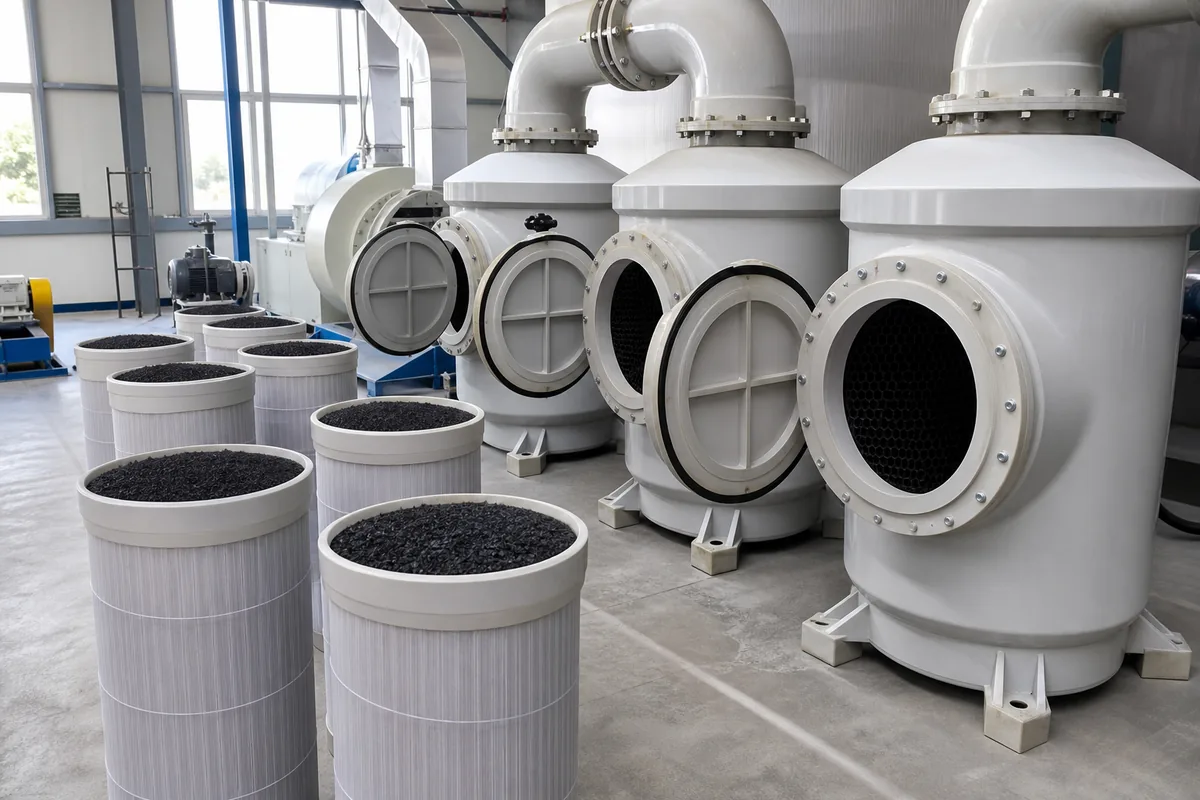
The exact procedure depends on vessel design, but the following sequence works for many fixed-bed PP, FRP, stainless steel, or carbon steel adsorbers.
- Shut down the process source or switch to standby treatment.
Confirm airflow has stopped or has been diverted through a safe bypass or second adsorber.
- Lock out and isolate the equipment.
Lock the fan, dampers, heaters, actuators, discharge equipment, and related pumps. Try-start the fan after lockout to confirm isolation.
- Purge and cool the adsorber.
Ventilate with clean air if allowed by site rules. Continue until VOC and LEL readings are acceptable. Carbon temperature should be close to ambient. If carbon temperature is above 50–60°C, investigate before opening fully.
- Open inspection ports slowly.
Stand to the side, not directly in front of the opening. Measure VOC, oxygen, LEL, and temperature near the opening. Stop if readings rise sharply.
- Remove spent carbon.
Use vacuum removal where possible. Manual shoveling is slower and creates more dust. Avoid damaging screens, support grids, PP internals, or distributor plates. Keep containers closed when not filling.
- Inspect the empty vessel.
Check for:
- Corrosion, cracks, swelling, or deformation.
- Broken support mesh or loose hold-down screens.
- Blocked gas distributor holes.
- Carbon fines accumulated in lower plenum.
- Liquid stains showing water carryover or condensation.
- Gasket damage on manways.
- Clean and repair before refilling.
Remove fines because they increase pressure drop and can be carried downstream. Replace damaged mesh and gaskets. For PP vessels, do not use flame or high heat for drying.
- Load new activated carbon evenly.
Confirm carbon grade and quantity. Fill slowly to reduce dust and segregation. Level the bed surface. Avoid standing directly on the carbon unless a load-spreading board is used. Uneven bed depth causes channeling and early breakthrough.
- Close and leak-check.
Install gaskets correctly and tighten manway bolts evenly. For plastic equipment, avoid over-tightening because it can deform flanges.
- Restart with controlled airflow.
Start at partial airflow if possible. Check pressure drop, vibration, fan current, and outlet VOC. Record the clean-bed pressure drop as the new baseline.
For estimating replacement quantity, use:
Carbon mass (kg) = bed volume (m³) × bulk density (kg/m³)
Typical bulk density:
- Pellet activated carbon: 450–550 kg/m³
- Granular activated carbon: 400–500 kg/m³
- Impregnated carbon: depends on formulation, often 450–600 kg/m³
Example: a vessel with 2.0 m diameter and 1.0 m bed depth has bed volume:
3.14 × (2.0² / 4) × 1.0 = 3.14 m³
If bulk density is 480 kg/m³:
3.14 × 480 = about 1,507 kg
Add a small allowance for handling loss, but do not overfill beyond the design bed height.
Downtime planning and common time allowances
Downtime depends on carbon quantity, access, removal method, vessel size, and permit requirements. Manual work through a small manway can be several times slower than vacuum unloading from a top hatch and bottom outlet.
| Task | Small adsorber, 300–800 kg carbon | Medium adsorber, 1–3 tonnes carbon | Notes |
|---|---|---|---|
| Isolation and gas testing | 1–2 h | 2–4 h | Longer if purging is difficult. |
| Opening and setup | 0.5–1 h | 1–2 h | Includes dust control and container setup. |
| Carbon removal | 2–5 h | 4–12 h | Vacuum removal is usually faster and cleaner. |
| Internal inspection and cleaning | 1–3 h | 2–6 h | More time if screens or mesh need repair. |
| Refilling and leveling | 1–3 h | 3–8 h | Big bags and hoist access reduce time. |
| Closing, leak check, restart | 1–2 h | 2–4 h | Record new baseline pressure drop. |
For planning, add 20–30% contingency if the adsorber has not been opened before, if spent carbon may be wet, or if access is poor. Wet carbon is heavy and difficult to vacuum. It also suggests upstream problems such as demister failure, condensation, or scrubber carryover.
If the plant cannot stop production, consider these design or operating options before the next change-out:
- Install two adsorbers in duty/standby or lead/lag arrangement.
- Add isolation dampers that seal properly.
- Provide larger access hatches and bottom discharge ports.
- Include sampling ports before and after each bed.
- Install differential pressure gauges across each vessel.
- Add upstream mist elimination or particulate filtration.
Lead/lag operation is useful because the first bed can be changed after breakthrough while the second bed protects the outlet. However, it needs correct valve operation and regular outlet monitoring. Do not run the second bed to exhaustion without a replacement plan.
Practical next step before your next shutdown
Prepare a one-page change-out sheet for each adsorber. Include vessel drawing, carbon grade, design carbon mass, last clean-bed pressure drop, isolation points, required PPE, waste container type, and restart checks. Before ordering replacement carbon or booking a disposal contractor, measure the actual bed dimensions and confirm the VOC list from the process. This prevents wrong carbon selection, short delivery quantities, and unnecessary downtime during the activated carbon change out procedure.