Why Ammonia Is Usually Scrubbed with Acid
Ammonia is highly soluble in water, but water-only scrubbing is often unstable because absorbed ammonia raises the liquid pH. As pH increases, more ammonia stays in the free NH3 form and can strip back into the gas. For most industrial exhausts, a controlled acidic scrubbing liquor gives more reliable removal.
The main reaction is:
`text NH3 + H+ → NH4+ `
Common acids used in ammonia scrubbers include sulfuric acid, hydrochloric acid, phosphoric acid and sometimes nitric acid. Sulfuric acid is common because ammonium sulfate is relatively stable and useful in some cases, but the final choice depends on wastewater handling, by-product management, corrosion conditions and local chemical availability.
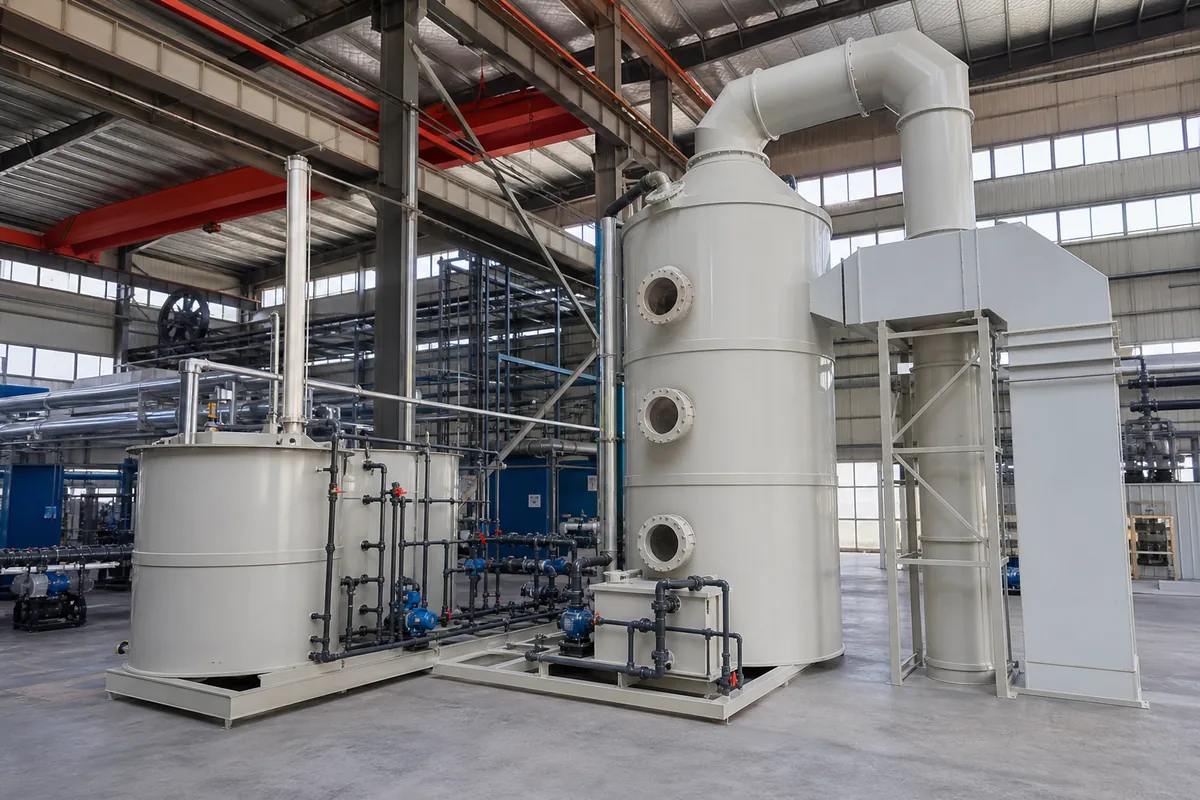
A typical acid scrubber for ammonia includes:
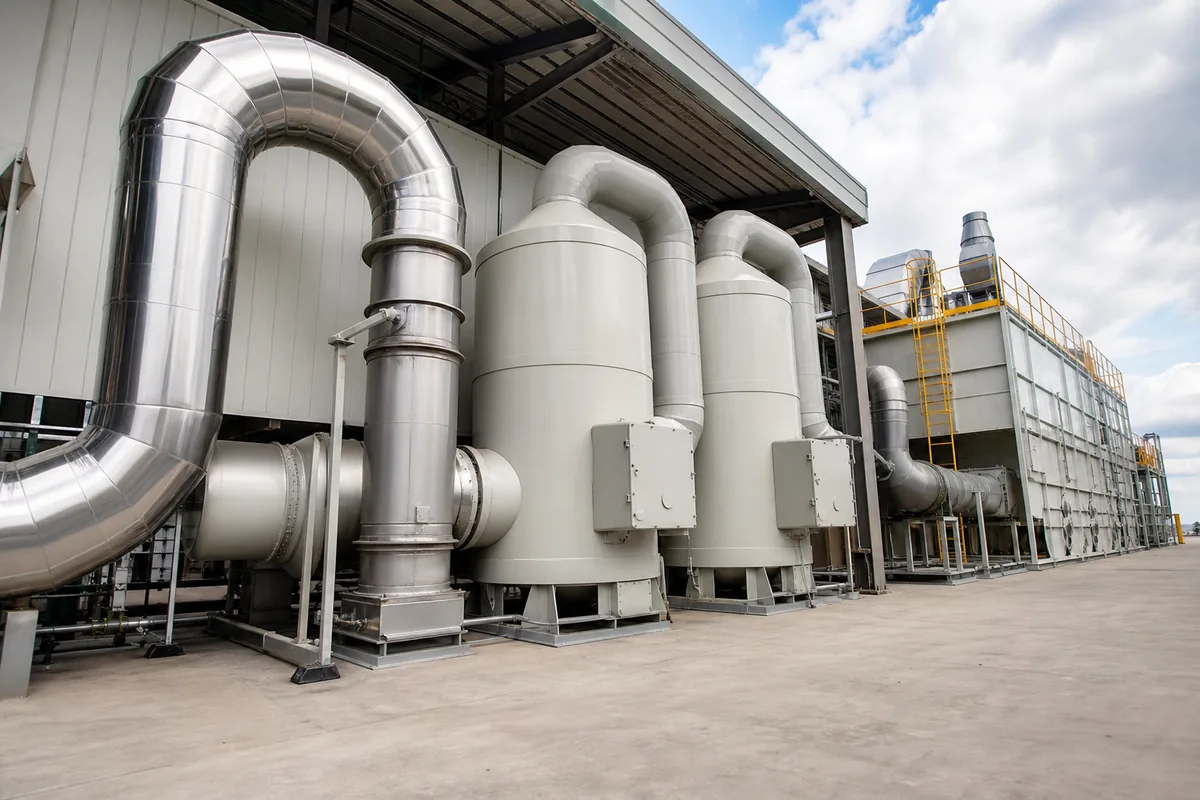
- PP or FRP packed tower body
- Acid-resistant circulation pump
- Packing layer, usually PP or PVDF depending on temperature and chemistry
- Spray distributor
- Mist eliminator
- pH control system with acid dosing pump
- Scrubbing liquor tank or sump
- Corrosion-resistant exhaust fan
- Ducting, often PP, FRP or stainless steel depending on the process
For many exhaust streams, practical outlet ammonia concentrations are achievable when the inlet concentration, gas flow, pH, packing depth and liquid distribution are correctly designed. However, guaranteed removal efficiency always depends on real inlet conditions and operating control.
Key Data Needed Before Ammonia Scrubber Design
Good ammonia scrubber design starts with correct process data. Many problems in the field come from incomplete inlet information, especially peak ammonia concentration and temperature.
Collect at least the following:
| Design item | Typical unit | Why it matters |
|---|---|---|
| Gas flow rate | m³/h or Nm³/h | Determines tower diameter, fan size and pressure drop |
| Gas temperature | °C | Affects material, vapor pressure, solubility and water evaporation |
| Ammonia concentration | ppmv or mg/m³ | Determines acid consumption and packing height |
| Peak concentration | ppmv or mg/m³ | Important for pH control and safety margin |
| Gas humidity | %RH or saturated/not saturated | Affects evaporation and mist formation |
| Dust or aerosol content | mg/m³ | May require pre-filtering or pre-scrubbing |
| Required outlet limit | ppmv or mg/m³ | Determines removal efficiency requirement |
| Operation schedule | h/day | Used for chemical consumption and tank sizing |
| Waste liquor limits | pH, salt, nitrogen | Affects blowdown and wastewater treatment |
If ammonia is given in ppmv, convert to mg/m³ at 25°C and 1 atm using:
`text mg/m³ = ppmv × molecular weight / 24.45 `
For ammonia:
`text mg/m³ NH3 = ppmv × 17.03 / 24.45 ≈ ppmv × 0.696 `
Example: 1,000 ppmv NH3 ≈ 696 mg/m³
For normal cubic metres, use the relevant standard condition. Do not mix actual m³/h and Nm³/h when calculating mass load.
The ammonia mass load is:
`text NH3 load, kg/h = gas flow, m³/h × NH3 concentration, mg/m³ ÷ 1,000,000 `
Example:
`text Gas flow = 10,000 m³/h NH3 concentration = 700 mg/m³
NH3 load = 10,000 × 700 ÷ 1,000,000 = 7 kg/h `
This value is the starting point for acid dosing and salt generation.
Acid Selection, pH Control and Chemical Consumption
The scrubber liquor must be acidic enough to keep absorbed ammonia as ammonium ion NH4+. In many systems, the operating pH is controlled between 2.0 and 5.5.
Common practical ranges are:
- pH 2.0–3.5: high removal duty, high inlet ammonia, strict outlet limit
- pH 3.5–5.0: general industrial ammonia exhaust
- pH 5.0–6.0: lower removal duty, lower acid use, but less safety margin
- Above pH 6.5: higher risk of ammonia slip, usually not recommended for final control
The best pH depends on gas loading, outlet target, packing design and wastewater requirements. A lower pH improves absorption but increases acid consumption, corrosion stress, mist risk and neutralization load downstream.
For sulfuric acid, the simplified reaction is:
`text 2 NH3 + H2SO4 → (NH4)2SO4 `
Molecular weights:
`text NH3 = 17.03 H2SO4 = 98.08 `
Theoretical pure sulfuric acid required:
`text kg H2SO4 = kg NH3 × 98.08 / (2 × 17.03) ≈ kg NH3 × 2.88 `
For commercial 98% sulfuric acid:
`text kg 98% H2SO4 ≈ kg NH3 × 2.88 / 0.98 ≈ kg NH3 × 2.94 `
For the example above with 7 kg/h NH3:
`text 98% H2SO4 required ≈ 7 × 2.94 ≈ 20.6 kg/h `
Add an operating margin, commonly 10–30%, depending on control stability and peak load. Do not oversize the acid pump too much; very large dosing pulses can cause pH swings and localized low pH.
Acid selection comparison:
| Acid | Main salt formed | Advantages | Points to check |
|---|---|---|---|
| Sulfuric acid | Ammonium sulfate | Common, strong acid, low volatility | Scaling risk if salt concentration is high; exothermic dilution |
| Hydrochloric acid | Ammonium chloride | Easy pH control, strong acid | HCl fumes, chloride corrosion, white salt mist risk |
| Phosphoric acid | Ammonium phosphate | Lower volatility, useful in some fertilizer-related sites | Higher viscosity/concentration effects, possible precipitation |
| Nitric acid | Ammonium nitrate | Strong acid | Oxidizing chemical, safety and storage requirements |
For PP scrubbers, sulfuric acid and hydrochloric acid are commonly handled at normal temperatures, but material compatibility must consider concentration, temperature and all contaminants in the gas. At elevated temperatures or with oxidizers, confirm material selection carefully.
Tower Sizing: Diameter, Packing and Liquid Rate
A vertical packed tower is the most common configuration for ammonia acid scrubbing. The tower diameter is mainly selected by superficial gas velocity.
For PP packed scrubbers, typical design gas velocity is:
`text 1.2–2.0 m/s for general duty 0.8–1.5 m/s for high removal or mist-sensitive duty 2.0–2.5 m/s only for low duty or limited space, with pressure drop check `
Tower cross-sectional area:
`text Area, m² = actual gas flow, m³/s ÷ gas velocity, m/s `
Tower diameter:
`text Diameter, m = √(4 × Area / π) `
Example:
`text Gas flow = 10,000 m³/h = 2.78 m³/s Selected gas velocity = 1.6 m/s
Area = 2.78 / 1.6 = 1.74 m² Diameter = √(4 × 1.74 / 3.1416) ≈ 1.49 m `
A practical selected internal diameter may be 1,500 mm.
Packing depth depends on required removal and inlet load. Typical starting points:
- 1.0–1.5 m packing: low inlet concentration or odor polishing
- 1.5–2.5 m packing: general industrial ammonia scrubbing
- 2.5–4.0 m packing: high concentration, strict outlet, or variable loading
- Two-stage design: useful when inlet load is high or outlet target is very low
Packing type is often PP Pall rings, Tellerette packing or structured plastic packing. Random PP packing sizes of 25–76 mm are common. Smaller packing gives higher surface area but higher pressure drop and more plugging risk.
The liquid-to-gas ratio, often called L/G, is a useful rule of thumb:
`text L/G = circulation liquid flow / gas flow `
For ammonia acid scrubbers:
`text 1.5–4.0 L/m³ gas is common 3.0–6.0 L/m³ gas for high duty or hot/dry gas `
Example for 10,000 m³/h gas and 2.5 L/m³:
`text Circulation flow = 10,000 × 2.5 L/h = 25,000 L/h = 25 m³/h `
This is circulation flow, not wastewater blowdown. Acid dosing is based on ammonia load and pH control, while blowdown is based on salt concentration and liquid quality.
Pressure drop is usually in the range of:
`text 500–1,500 Pa for a complete packed scrubber `
Higher values are possible with deep packing, small packing, high gas velocity, fouling or mist eliminators. The fan should be selected with margin for wet operation and future fouling, but excessive margin may increase noise and energy use.
Mist, Salt, Scaling and Waste Liquor Control
Ammonia scrubbers can create ammonium salt mist if gas velocity is high, pH is too low, or the system is overloaded. A good mist eliminator is important, especially when acid mist or ammonium salt carryover can affect downstream fans, stacks or surroundings.
Common demister design points:
- Use PP chevron or mesh pad demisters depending on mist load.
- Keep face velocity commonly around 2–4 m/s for chevron type, depending on design.
- Provide wash nozzles if salt deposition is expected.
- Allow access doors for cleaning.
- Install a drain path so collected liquid returns to the sump.
Salt concentration in the liquor increases as ammonia is absorbed. If sulfuric acid is used, ammonium sulfate concentration can become high. High salt content may lead to crystallization, pump wear, blocked spray nozzles and packing fouling.
Control methods include:
- Continuous or batch blowdown from the sump
- Fresh water make-up to control conductivity or density
- Conductivity monitoring as an indirect salt control
- Side-stream filtration if solids or dust are present
- Periodic washing of packing and demister
The approximate ammonium sulfate produced from ammonia is:
`text kg (NH4)2SO4 = kg NH3 × 132.14 / (2 × 17.03) ≈ kg NH3 × 3.88 `
For 7 kg/h NH3:
`text Ammonium sulfate formed ≈ 7 × 3.88 ≈ 27.2 kg/h `
This salt must leave the system in blowdown or recovered liquor. If not, it will accumulate.
The required blowdown depends on allowed salt concentration:
`text Blowdown, m³/h ≈ salt production, kg/h ÷ allowed salt concentration, kg/m³ `
If allowed salt concentration is 100 kg/m³:
`text Blowdown ≈ 27.2 / 100 ≈ 0.27 m³/h `
This is a simplified estimate. Real blowdown also depends on evaporation, make-up water quality, other contaminants and wastewater limits.
Practical Next Step
Before requesting an ammonia scrubber design, prepare one data sheet with gas flow, temperature, ammonia concentration, peak value, required outlet limit, operating hours, dust content and wastewater restrictions. With these values, the supplier can calculate tower diameter, packing depth, circulation rate, acid consumption, salt production, blowdown estimate and fan pressure more accurately.